
|
You entered: disk
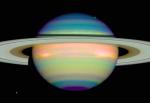 Infrared Saturn
22.02.2003
This delightfully detailed false-color image of Saturn was taken in January 1998 by the orbiting Hubble Space Telescope. The picture is a combination of three images from Hubble's NICMOS instrument and shows the lovely ringed planet in reflected infrared sunlight.
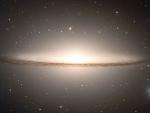 The Sombrero Galaxy from VLT
28.02.2000
Why does the Sombrero Galaxy look like a hat? Reasons include the Sombrero's unusually large and extended central bulge of stars, and dark prominent dust lanes that appear in a disk that we see nearly edge-on. Billions of old stars cause the diffuse glow of the extended central bulge.
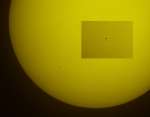 Atlantis and Hubble Side by Side
16.05.2009
On Wednesday, May 13, two, tiny, fast moving spots crossed an otherwise featureless solar disk. Not sunspots though, the dark blemishes were silhouettes of the shuttle orbiter Atlantis and the Hubble Space Telescope side by side.
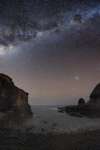 The Milky Way Over Pulpit Rock
5.07.2010
Can a picture of the sky be relaxing? A candidate for such a picture might be the above image taken only last month from Cape Schank, Victoria, Australia. The frame is highlighted by a quiet lagoon, soft ground fog, two galaxies, and tens of thousands of stars.
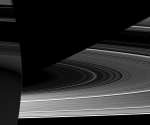 Saturn: Light, Dark, and Strange
12.10.2010
What's creating those dark bands on Saturn? Sometimes it takes a little sleuthing to figure out the how and why of a picture taken by the Saturn-orbiting Cassini spacecraft. Let's see. That large orb on the left must be Saturn itself. Those arcs on the right are surely the rings.
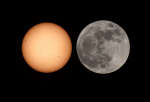 Sun vs Super Moon
11.05.2012
The Super Moon wins, by just a little, when its apparent size is compared to the Sun in this ingenious composite picture. To make it, the Full Moon on May 6 was photographed with the same camera and telescope used to image the Sun (with a dense solar filter!) on the following day.
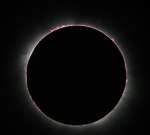 Solar Eclipse from Uganda
8.11.2013
The Sun's disk was totally eclipsed for a brief 20 seconds as the Moon's dark umbral shadow raced across Pokwero in northwestern Uganda on November 3rd. So this sharp telescopic view of totality in clear skies from the central African locale was much sought after by eclipse watchers.
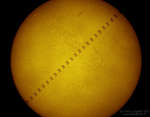 ISS and Mercury Too
13.05.2016
Transits of Mercury are relatively rare. Monday's leisurely 7.5 hour long event was only the 2nd of 14 Mercury transits in the 21st century. If you're willing to travel, transits of the International Space Station can be more frequent though, and much quicker.
 Tracking Saturn's Moons
12.05.1996
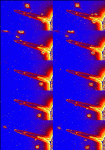
These five pairs of Hubble Space Telescope images track some of Saturn's moons as they orbit the ringed planet. A pair of images was taken every 97 minutes on November 21, 1995 with the Wide Field Planetary Camera-2, the normally bright ring system appearing nearly edge-on.
 Bright Spiral Galaxy M81
18.11.2014
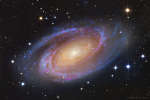
One of the brightest galaxies in planet Earth's sky is similar in size to our Milky Way Galaxy: big, beautiful M81. This grand spiral galaxy can be found toward the northern constellation of the Great Bear (Ursa Major).
|
January February March April |
|||||||||||||||||||||||||||||||||||||||||||||||||