
|
You entered: disk
 Wide Field View of Great American Eclipse
30.01.2019
Only in the fleeting darkness of a total solar eclipse is the light of the solar corona easily visible. Normally overwhelmed by the bright solar disk, the expansive corona, the sun's outer atmosphere, is an alluring sight.
 APOD: 2024 May 29 Б Stairway to the Milky Way
29.05.2024
What happens if you ascend this stairway to the Milky Way? Before answering that, let's understand the beautiful sky you will see. Most eye-catching is the grand arch of the Milky Way Galaxy...
 Spiral Galaxy NGC 6744
1.11.2024
Big, beautiful spiral galaxy NGC 6744 is nearly 175,000 light-years across, larger than our own Milky Way. It lies some 30 million light-years distant in the southern constellation Pavo but appears as only a faint smudge in the eyepiece of a small telescope.
 APOD: 2026 February 8 Б Active Sunspot Region 4366 Crosses the Sun
8.02.2026
An unusually active sunspot region is now crossing the Sun. The region, labelled AR 4366, is much larger than the Earth and has produced several powerful solar flares over the past ten days. In the featured image, the region is marked by large and dark sunspots toward the upper right of the Sun's disk.
 The T Tauri Star Forming System
4.06.2001
What did the Sun look like before there were planets? A prototype laboratory for the formation of low mass stars like our Sun is the T Tauri system, one of the brighter star systems toward the constellation of Taurus. In young systems, gravity causes a gas cloud to condense.
 The Milky Way Over the Arizona Toadstools
22.02.2015
Which is older -- the rocks you see on the ground or the light you see from the sky? Usually its the rocks that are older, with their origin sentiments deposited well before light left any of the stars or nebulas you see in the sky.
 A Powerful Solar Flare
29.10.2003
Yesterday, our Sun produced one of the most powerful solar flares in recorded history. Seen across the electromagnetic spectrum, the Sun briefly became over 100 times brighter in X-rays than normal. Over the next few days, as energetic particles emitted from these regions strike the Earth, satellite communications might be affected and auroras might develop.
 Irregular Galaxy NGC 55
12.08.2009
Irregular galaxy NGC 55 is thought to be similar to the Large Magellanic Cloud (LMC). But while the LMC is about 180,000 light-years away and is a well known satellite of our own Milky Way Galaxy, NGC 55 is more like 6 million light-years distant and is a member of the Sculptor Galaxy Group.
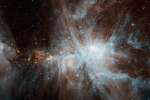 Spitzer s Orion
10.04.2010
Few cosmic vistas excite the imagination like the Orion Nebula, an immense stellar nursery some 1,500 light-years away. Spanning about 40 light-years across the region, this new infrared image from the Spitzer Space...
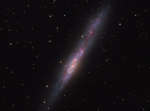 Irregular Galaxy NGC 55
21.09.2018
Irregular galaxy NGC 55 is thought to be similar to the Large Magellanic Cloud (LMC). But while the LMC is about 180,000 light-years away and is a well known satellite of our own Milky Way Galaxy, NGC 55 is more like 6 million light-years distant and is a member of the Sculptor Galaxy Group.
|
January February March April May |
|||||||||||||||||||||||||||||||||||||||||||||||||