
|
You entered: infrared
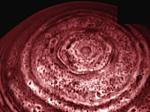 A Mysterious Hexagonal Cloud System on Saturn
3.04.2007
Why would clouds form a hexagon on Saturn? Nobody is yet sure. Originally discovered during the Voyager flybys of Saturn in the 1980s, nobody has ever seen anything like it anywhere else in the Solar System.
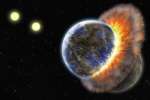 The Case of the Very Dusty Binary Star
25.09.2008
For astronomers, close binary star system BD+20 307 originally stood out because it is extremely dusty. A substantial amount of warm dust surrounding it causes the system to appear exceptionally bright at infrared wavelengths. Of course, dust associated with planet formation is often detected around young stars, stars only a few million years old.
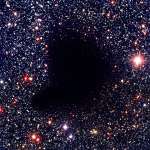 Molecular Cloud Barnard 68
23.06.2009
Where did all the stars go? What used to be considered a hole in the sky is now known to astronomers as a dark molecular cloud. Here, a high concentration of dust and molecular gas absorb practically all the visible light emitted from background stars.
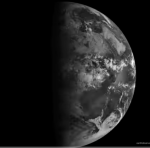 Equinox on Planet Earth
20.03.2019
Welcome to an equinox on planet Earth. Today is the first day of spring in our fair planet's northern hemisphere, fall in the southern hemisphere, with day and night nearly equal around the globe.
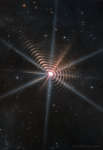 Dust Shells around WR 140 from Webb
13.10.2022
What are those strange rings? Rich in dust, the rings are likely 3D shells -- but how they were created remains a topic of research. Where they were created is well known: in a binary...
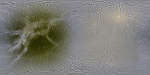 The Map of Dione
6.11.2014
This cylindrical projection global map is one of six new color maps of Saturn's midsized icy moons, constructed using 10 years of image data from the Cassini spacecraft. Discovered by Cassini (the astronomer) in 1684, Dione is about 1,120 kilometers across.
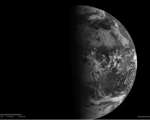 Equinox on a Spinning Earth
19.03.2017
When does the line between day and night become vertical? Tomorrow. Tomorrow is an equinox on planet Earth, a time of year when day and night are most nearly equal. At an equinox, the Earth's terminator -- the dividing line between day and night -- becomes vertical and connects the north and south poles.
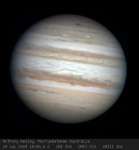 Jupiter s Impact Scar
23.07.2009
In July of 1994 pieces of Comet Shoemaker-Levy 9 collided with planet Jupiter. The explosive impacts sent plumes of debris high into the Jovian atmosphere creating dark markings or scars, visible for a time against the cloud bands.
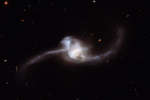 NGC 2623: Galaxy Merger from Hubble
9.11.2009
Where do stars form when galaxies collide? To help find out, astronomers imaged the nearby galaxy merger NGC 2623 in high resolution with the Hubble Space Telescope in 2007. Analysis of this Hubble image...
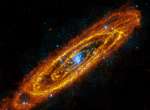 The Once and Future Stars of Andromeda
20.01.2011
The big, beautiful Andromeda Galaxy, aka M31, is a spiral galaxy a mere 2.5 million light-years away. Two space-based observatories have combined to produce this intriguing composite image of Andromeda, at wavelengths outside the visible spectrum. The remarkable view follows the locations of this galaxy's once and future stars.
|
January February March April May June July August September October |
|||||||||||||||||||||||||||||||||||||||||||||||||