
|
You entered: infrared
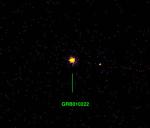 GRB010222: Gamma Ray Burst, X Ray Afterglow
13.04.2001
A fading afterglow from one of the most powerful explosions in the universe is centered in this false color image from the spacebased Chandra X-ray Observatory. The cosmic explosion, an enormously bright gamma-ray burst (GRB), originated in a galaxy billions of light-years away and was detected by the BeppoSAX satellite on February 22.
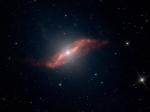 The Galaxy Within Centaurus A
24.06.2004
Peering deep inside Centaurus A, the closest active galaxy to Earth, the Spitzer Space Telescope's penetrating infrared cameras recorded this startling vista. About 1,000 light-years across, the twisted cosmic dust cloud apparently shaped like a parallelogram is likely the result of a smaller spiral galaxy falling into the giant Centaurus A.
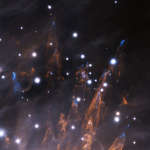 The Orion Bullets
10.01.2013
Cosmic bullets pierce the outskirts of the Orion Nebula some 1500 light-years distant in this sharp infrared close-up. Blasted out by energetic massive star formation the bullets, relatively dense, hot gas clouds about ten times the size of Pluto's orbit, are blue in the false color image.
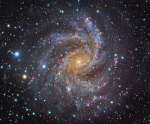 Facing NGC 6946
24.02.2018
From our vantage point in the Milky Way Galaxy, we see NGC 6946 face-on. The big, beautiful spiral galaxy is located just 10 million light-years away, behind a veil of foreground dust and stars in the high and far-off constellation of Cepheus.
 APOD: 2024 June 23 Б The Colors of Saturn from Cassini
23.06.2024
What creates Saturn's colors? The featured picture of Saturn only slightly exaggerates what a human would see if hovering close to the giant ringed world. The image was taken in 2005 by the robot Cassini spacecraft that orbited Saturn from 2004 to 2017.
 Journey to the Center of the Galaxy
2.07.2012
What wonders lie at the center of our Galaxy? In Jules Verne's science fiction classic A Journey to the Center of the Earth, Professor Liedenbrock and his fellow explorers encounter many strange and exciting wonders.
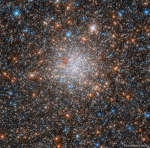 NGC 1898: Globular Cluster in the LMC
3.10.2018
Jewels don't shine this bright -- only stars do. And almost every spot in this glittering jewel-box of an image from the Hubble Space Telescope is a star. Now some stars are more red than our Sun, and some more blue -- but all of them are much farther away.
 Mars: The View from HiRISE
10.04.2006
HiRISE - the High Resolution Imaging Science Experiment - rides on the Mars Reconnaissance Orbiter (MRO)spacecraft just arrived in Mars orbit on March 10. This sharp view of the martian surface from the HiRISE camera includes image data with a full resolution of about 2.5 meters per pixel - recorded from a range of 2,500 kilometers.
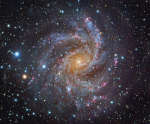 Facing NGC 6946
9.01.2012
From our vantage point in the Milky Way Galaxy, we see NGC 6946 face-on. The big, beautiful spiral galaxy is located just 10 million light-years away, behind a veil of foreground dust and stars in the high and far-off constellation of Cepheus.
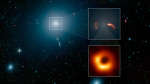 The Galaxy, the Jet and the Black Hole
27.04.2019
Bright elliptical galaxy Messier 87 (M87) is home to the supermassive black hole captured by planet Earth's Event Horizon Telescope in the first ever image of a black hole. Giant of the Virgo...
|
January February March April May June July August September October |
|||||||||||||||||||||||||||||||||||||||||||||||||