
|
You entered: camera
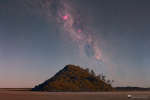 Carina over Lake Ballard
5.01.2018
A jewel of the southern sky, the Great Carina Nebula, also known as NGC 3372, is one of our galaxy's largest star forming regions. Easily visible to the unaided eye it stands high...
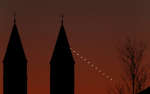 The Last Days of Venus as the Evening Star
6.01.2022
That's not a young crescent Moon posing behind cathedral towers after sunset. It's Venus in a crescent phase. About 40 million kilometers away and about 2 percent illuminated by sunlight...
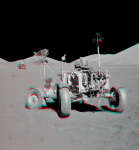 Apollo 17 VIP Site Anaglyph
17.12.2022
Get out your red/blue glasses and check out this stereo scene from Taurus-Littrow valley on the Moon! The color anaglyph features a detailed 3D view of Apollo 17's Lunar Rover in the foreground -- behind it lies the Lunar Module and distant lunar hills.
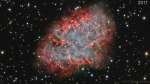 APOD: 2023 March 20 Б M1: The Expanding Crab Nebula
20.03.2023
Are your eyes good enough to see the Crab Nebula expand? The Crab Nebula is cataloged as M1, the first on Charles Messier's famous list of things which are not comets. In fact...
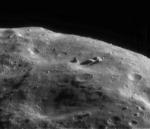 Eros Horizon View
25.05.2000
Since April 30, the robotic NEAR-Shoemaker spacecraft has been orbiting only 31 miles from asteroid Eros. Cruising over the asteroid's north and south poles at a leisurely 7 miles per hour, the spacecraft completes an orbit once every 1.2 earth days. This dramatic horizon view
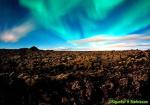 Aurora Over Clouds
2.04.2001
Aurorae usually occur high above the clouds. The auroral glow is created when fast-moving particles ejected from the Sun impact air molecules high in the Earth's atmosphere. An oxygen molecule, for example, will glow in a green light when reacquiring an electron lost during a collision with a solar particle.
 At the Core of M15
20.11.1995
Densely packed stars in the core of the globular cluster M15 are shown in this Hubble Space Telescope (HST) image taken in April of 1994. The stars revealed are contained in an area 1.6 light years across and their colors roughly indicate their temperatures - hot stars appear blue, cooler stars look reddish-orange.
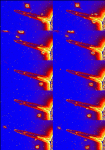 Tracking Saturn's Moons
12.05.1996
These five pairs of Hubble Space Telescope images track some of Saturn's moons as they orbit the ringed planet. A pair of images was taken every 97 minutes on November 21, 1995 with the Wide Field Planetary Camera-2, the normally bright ring system appearing nearly edge-on.
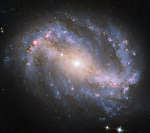 Barred Spiral Galaxy NGC 6217
28.12.2009
Many spiral galaxies have bars across their centers. Even our own Milky Way Galaxy is thought to have a modest central bar. Prominently barred spiral galaxy NGC 6217, pictured above, was captured in spectacular detail in this recently released image taken by the newly repaired Advanced Camera for Surveys on the orbiting Hubble Space Telescope.
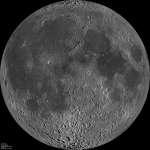 Lunar Nearside
3.03.2011
About 1,300 images from the Lunar Reconnaissance Orbiter spacecraft's wide angle camera were used to compose this spectacular view of a familiar face - the lunar nearside. But why is there a lunar nearside? The Moon rotates on its axis and orbits the Earth at the same rate, about once every 28 days.
|
January February March April May June July August |
||||||||||||||||||||||||||||||||||||||||||||||||||||||||