
|
You entered: color
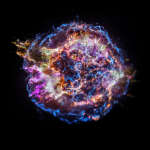 Recycling Cassiopeia A
28.12.2017
Massive stars in our Milky Way Galaxy live spectacular lives. Collapsing from vast cosmic clouds, their nuclear furnaces ignite and create heavy elements in their cores. After a few million years, the enriched material is blasted back into interstellar space where star formation can begin anew.
 APOD: 2023 October 10 Б Hidden Orion from Webb
10.10.2023
The Great Nebula in Orion has hidden stars. To the unaided eye in visible light, it appears as a small fuzzy patch in the constellation of Orion. But this image was taken by the Webb Space Telescope in a representative-color composite of red and very near infrared light.
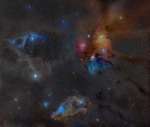 Rho Ophiuchus Wide Field
24.05.2010
The clouds surrounding the star system Rho Ophiucus compose one of the closest star forming regions. Rho Ophiucus itself is a binary star system visible in the light-colored region on the image right.
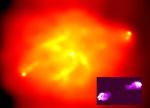 X Ray Cygnus A
5.10.2002
Amazingly detailed, this false-color x-ray image is centered on the galaxy Cygnus A. Recorded by the orbiting Chandra Observatory, Cygnus A is seen here as a spectacular high energy x-ray source. But it is actually more famous at the low energy end of the electromagnetic spectrum as one of the brightest celestial radio sources.
 X-Ray Ring Around SN1987A
12.05.2000
This false-color image from the Chandra X-ray Observatory reveals a one light-year diameter ring of hot, ten million degree plasma. It is one of the most detailed X-ray images of the expanding blast wave from supernova 1987A (SN1987A).
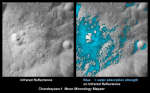 Water Discovered on the Moon
28.09.2009
Water has been discovered on the surface of the Moon. No lakes have been found, but rather NASA's Moon Mineralogy Mapper aboard India's new Chandrayaan-1 lunar orbiter radios back that parts of the Moon's surface absorb a very specific color of light identified previously only with water.
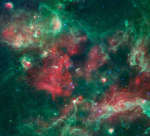 Cygnus X: The Inner Workings of a Nearby Star Factory
18.01.2012
How do stars form? To help study this complex issue, astronomers took a deep infrared image of Cygnus X, the largest known star forming region in the entire Milky Way Galaxy. The above recently-released...
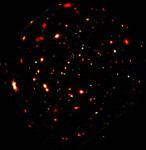 The Cosmic X-Ray Background
9.11.2000
Early on, x-ray satellites revealed a surprising cosmic background glow of x-rays and astronomers have struggled to understand its origin. Now, peering through a hole in the obscuring gas and dust...
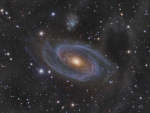 Grand Spiral Galaxy M81 and Arps Loop
16.04.2013
One of the brightest galaxies in planet Earth's sky is similar in size to our Milky Way Galaxy: big, beautiful M81. This grand spiral galaxy lies 11.8 million light-years away toward the northern constellation of the Great Bear (Ursa Major).
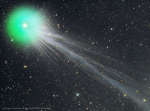 The Complex Ion Tail of Comet Lovejoy
20.01.2015
What causes the structure in Comet Lovejoy's tail? Comet C/2014 Q2 (Lovejoy), which is currently at naked-eye brightness and near its brightest, has been showing an exquisitely detailed ion tail. As the name...
|
January February March April May June July August September October |
|||||||||||||||||||||||||||||||||||||||||||||||||