
|
You entered: dust
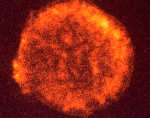 Tycho's Supernova Remnant in X-ray
23.06.1996
How often do stars explode? By looking at external galaxies, astronomers can guess that these events, known as a supernovae, should occur about once every 30 years in a typical spiral galaxy like our MilkyWay.
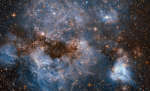 N159 in the Large Magellanic Cloud
28.01.2017
Over 150 light-years across, this cosmic maelstrom of gas and dust is not too far away. It lies south of the Tarantula Nebula in our satellite galaxy the Large Magellanic Cloud a mere 180,000 light-years distant. Massive stars have formed within.
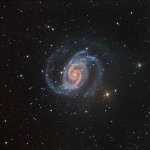 NGC 1566: The Spanish Dancer Spiral Galaxy
14.01.2022
An island universe of billions of stars, NGC 1566 lies about 60 million light-years away in the southern constellation Dorado. Popularly known as the Spanish Dancer galaxy, it's seen face-on from our Milky Way perspective.
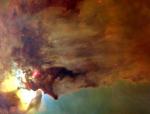 In the Center of the Lagoon Nebula
4.03.2003
The center of the Lagoon Nebula is busy with the awesome spectacle of star formation. Visible in the lower left, at least two long funnel-shaped clouds, each roughly half a light-year long, have been formed by extreme stellar winds and intense energetic starlight. The tremendously bright nearby star, Hershel 36, lights the area.
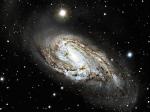 Unusual Spiral Galaxy M66
7.04.2004
Why isn't spiral galaxy M66 symmetric? Usually density waves of gas, dust, and newly formed stars circle a spiral galaxy's center and create a nearly symmetric galaxy. The differences between...
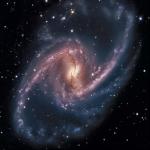 NGC 1365: Majestic Island Universe
28.03.2007
Barred spiral galaxy NGC 1365 is truly a majestic island universe some 200,000 light-years across. Located a mere 60 million light-years away toward the chemical constellation Fornax, NGC 1365 is a dominant member of the well-studied Fornax galaxy cluster.
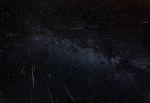 Raining Perseids
20.08.2004
Comet dust rained down on planet Earth last week, streaking through dark skies in the annual Perseid meteor shower. So, while enjoying the anticipated space weather, astronomer Fred Bruenjes recorded a series of many 30 second long exposures spanning about six hours on the night of August 11/12 using a wide angle lens.
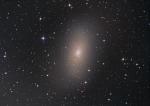 Messier 110
8.09.2006
This very sharp telescopic vista features the last object in the modern version of Charles Messier's catalog of bright clusters and nebulae - Messier 110. A dwarf elliptical galaxy, M110 (aka NGC 205) is actually a bright satellite of the large spiral galaxy Andromeda, making M110 a fellow member of the local group of galaxies.
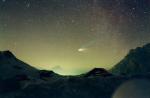 Comet Hale-Bopp Over Val Parola Pass
8.08.1999
Comet Hale-Bopp became much brighter than any surrounding stars. It was seen even over bright city lights. Out away from city lights, however, it put on quite a spectacular show. Here Comet Hale-Bopp was photographed above Val Parola Pass in the Dolomite mountains surrounding Cortina d'Ampezzo, Italy.
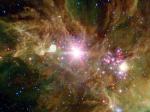 The Snowflake Cluster versus the Cone Nebula
9.05.2007
Strange shapes and textures can be found in the neighborhood of the Cone Nebula. These patterns result from the tumultuous unrest that accompanies the formation of the open cluster of stars known as NGC 2264, the Snowflake cluster.
|
January February March April May June July August September October |
|||||||||||||||||||||||||||||||||||||||||||||||||