
|
You entered: dust
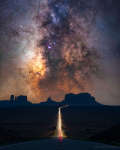 APOD: 2025 November 9 Б Road to the Galactic Center
9.11.2025
Does the road to our galaxy's center go through Monument Valley? It doesn't have to, but if your road does -- take a picture. In this case, the road is US Route 163 and iconic buttes on the Navajo National Reservation populate the horizon.
 Yellow Balls in W33
30.01.2015
Infrared wavelengths of 3.6, 8.0, and 24.0 microns observed by the Spitzer Space Telescope are mapped into visible colors red, green, and blue in this striking image. The cosmic cloud of gas and dust is W33, a massive starforming complex some 13,000 light-years distant, near the plane of our Milky Way Galaxy.
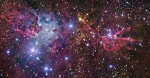 Fox Fur, a Unicorn, and a Christmas Tree
25.12.2008
Clouds of glowing hydrogen gas fill this colorful skyscape in the faint but fanciful constellation Monoceros, the Unicorn. A star forming region cataloged as NGC 2264, the complex jumble of cosmic gas and dust...
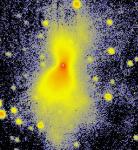 Cold Wind From The Boomerang Nebula
15.10.1997
A cold wind blows from the central star of the Boomerang Nebula. Seen here in a false color image of dust reflected starlight, the nebula lies about 5,000 light-years away. The boomerang shaped...
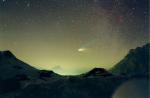 Comet Hale Bopp Over Val Parola Pass
14.03.2004
Comet Hale-Bopp became much brighter than any surrounding stars. It was seen even over bright city lights. Out away from city lights, however, it put on quite a spectacular show. Here Comet Hale-Bopp was photographed above Val Parola Pass in the Dolomite mountains surrounding Cortina d'Ampezzo, Italy.
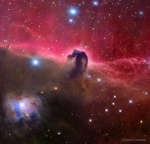 The Magnificent Horsehead Nebula
13.05.2015
Sculpted by stellar winds and radiation, a magnificent interstellar dust cloud by chance has assumed this recognizable shape. Fittingly named the Horsehead Nebula, it is some 1,500 light-years distant, embedded in the vast Orion cloud complex.
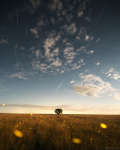 Geminds of the South
16.12.2021
Fireflies flash along a moonlit countryside in this scene taken on the night of December 13/14 from southern Uruguay, planet Earth. On that night meteors fell in the partly cloudy skies above during the annual Geminid meteor shower.
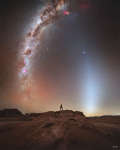 APOD: 2026 July 6 Б Dueling Bands over the Atacama Desert
6.07.2026
What are these two bands in the sky? The more commonly seen band is on the left and is the central band of our Milky Way galaxy. Our Sun orbits in the disk of this spiral galaxy so that from inside, it appears as a band of comparable brightness all the way around the sky.
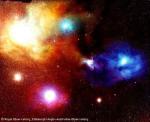 Antares and Rho Ophiuchi
9.05.2004
Why is the sky near Antares and Rho Ophiuchi so colorful? The colors result from a mixture of objects and processes. Fine dust illuminated from the front by starlight produces blue reflection nebulae. Gaseous clouds whose atoms are excited by ultraviolet starlight produce reddish emission nebulae. Backlit dust clouds block starlight and so appear dark.
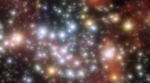 Journey to the Center of the Galaxy
29.07.2018
What wonders lie at the center of our Galaxy? In Jules Verne's science fiction classic A Journey to the Center of the Earth, Professor Liedenbrock and his fellow explorers encounter many strange and exciting wonders.
|
January February March April May June July August September October |
|||||||||||||||||||||||||||||||||||||||||||||||||