
|
You entered: dust
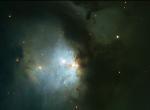 Reflection Nebula M78
24.04.2000
An eerie blue glow and ominous columns of dark dust highlight M78, a bright reflection nebula in the constellation of Orion. The dust not only absorbs light, but also reflects the light of several bright blue stars that formed recently in the nebula.
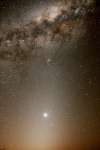 Venus, Zodiacal Light, and the Galactic Center
18.10.2013
The bulging center of our Milky Way Galaxy rests on a pillar of light in this luminous skyscape. Recorded on September 22nd in dark South African skies, rivers of dust seem to flow downward from the galactic center towards Antares, yellowish alpha star of the constellation Scorpius, near the top of the scene.
 The North America Nebula in Infrared
15.02.2011
The North America Nebula can do what most North Americans cannot -- form stars. Precisely where in the nebula these stars are forming has been mostly obscured by some of the nebula's thick dust that is opaque to visible light.
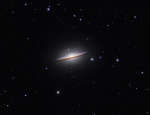 The Sombrero Galaxy from Hale
15.07.2013
What's going on in the center of this spiral galaxy? Named the Sombrero Galaxy for its hat-like resemblance, M104 features a prominent dust lane and a bright halo of stars and globular clusters.
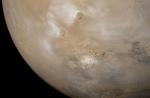 The Fogs of Mars
2.06.2003
Fogs of clouds and dust covered parts of southern Mars during last Martian winter. Giant volcanoes, such as Ascraeus Mons, the central circular feature near the top of the image, were surrounded by large water clouds. Slightly southwest, Pavonis Mons and Arisa Mons also peeked above their water clouds.
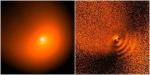 Hale-Bopp Polarized
25.04.1997
Light polarization is familiar to many outdoor enthusiasts who use polarizing sunglasses to cut the glare of reflected light. These two views of comet Hale-Bopp also demonstrate the effect of polarization. At left...
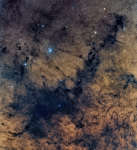 The Pipe Nebula
7.08.2020
East of Antares, dark markings sprawl through crowded star fields toward the center of our Milky Way Galaxy. Cataloged in the early 20th century by astronomer E. E. Barnard, the obscuring interstellar dust clouds include B59, B72, B77 and B78, seen in against the starry background.
 APOD: 2025 September 2 Б The Horsehead and Flame Nebulas
2.09.2025
The Horsehead Nebula is one of the most famous nebulae on the sky. It is visible as the dark indentation to the orange emission nebula at the far right of the featured picture. The horse-head feature is dark because it is really an opaque dust cloud that lies in front of the bright emission nebula.
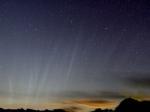 A Comet Tail Horizon
24.01.2007
What's happening over the horizon? Many a sky enthusiast who thought they had seen it all had never seen anything like this. To the surprise of many Northern Hemisphere observers, the tail of Comet McNaught remained visible even after the comet's head set ahead of the Sun.
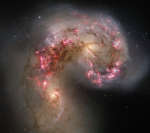 The Antennae Galaxies in Collision
18.07.2010
Two galaxies are squaring off in Corvus and here are the latest pictures. But when two galaxies collide, the stars that compose them usually do not. That's because galaxies are mostly empty space and, however bright, stars only take up only a small amount of that space.
|
January February March April May June July August September October |
|||||||||||||||||||||||||||||||||||||||||||||||||