
|
You entered: dust
 Fox Fur, a Unicorn, and a Christmas Tree
24.12.2016
Clouds of glowing hydrogen gas fill this colorful skyscape in the faint but fanciful constellation Monoceros, the Unicorn. A star forming region cataloged as NGC 2264, the complex jumble of cosmic gas and dust...
 Fox Fur, Unicorn, and Christmas Tree
7.02.2019
Clouds of glowing hydrogen gas fill this colorful skyscape in the faint but fanciful constellation Monoceros, the Unicorn. A star forming region cataloged as NGC 2264, the complex jumble of cosmic gas and dust...
 Trapezium: Teardrops in My Skies
28.02.1999
Sometimes the unexpected comes in a familiar shape. In this picture, the seemingly familiar teardrop-shaped object just right of center is actually an unusually situated disk of gas and dust. In fact, the teardrop is about the size of our own Solar System and is racing against time to condense and form planets.
 The Snake Nebula from CFHT
9.04.2002
What slithers overhead? The dark winding lanes visible in part of the constellation of Ophiuchus belong to the Snake Nebula. Also known as Barnard 72, the Snake Nebula is a series of dark absorption clouds made up of molecular gas and interstellar dust.
 Elements of the Swan Nebula
11.08.2003
In the depths of the dark clouds of dust and molecular gas known as M17, stars continue to form. Also known as the Omega Nebula and Horseshoe Nebula, the darkness of M17's molecular clouds results from background starlight being absorbed by thick filaments of carbon-based smoke-sized dust.
 Fomalhaut's Dusty Debris Disk
11.05.2023
Fomalhaut is a bright star, a 25 light-year voyage from planet Earth in the direction of the constellation Piscis Austrinus. Astronomers first noticed Fomalhaut's excess infrared emission in the 1980s. Space and ground-based...
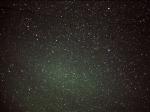 The Gegenschein
26.12.2006
If you look carefully enough, you can even see the glow of the Sun in the opposite direction. At night this glow is known as the gegenschein (German for "counter glow"), and can be seen as a faint glow in an extremely dark sky. The gegenschein is sunlight back-scattered off small interplanetary dust particles.
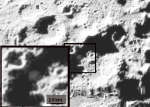 Water Discovered in Moon Shadow
18.11.2009
Why is there water on the Moon? Last month, the LCROSS mission crashed a large impactor into a permanently shadowed crater near the Moon's South Pole. A plume of dust rose that was visible to the satellite, although hard to discern from Earth. The plume is shown above in visible light.
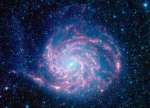 Spitzer s M101
30.12.2009
Big, beautiful spiral galaxy M101 is one of the last entries in Charles Messier's famous catalog, but definitely not one of the least. About 170,000 light-years across, this galaxy is enormous, almost twice the size of our own Milky Way Galaxy.
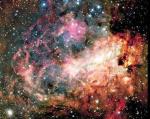 M17: Omega Nebula Star Factory
10.12.2002
In the depths of the dark clouds of dust and molecular gas known as M17, stars continue to form. The similarity to the Greek letter capital Omega gives the molecular cloud its popular name, but the nebula is also known as the Swan Nebula, the Horseshoe Nebula, and M17.
|
January February March April May June July August September October |
|||||||||||||||||||||||||||||||||||||||||||||||||