
|
You entered: atmosphere
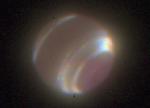 Neptune through Adaptive Optics
18.02.2000
From the Earth's surface, Neptune usually appears as a fuzzy blotch. The blurring effects of the Earth's atmosphere deny clearer images. By distorting mirrors in the telescope itself in time with the changing atmosphere, however, these effects can be greatly reduced.
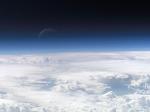 A Blue Crescent Moon from Space
20.03.2007
What's happening to the Moon? Drifting around the Earth in 2006 July, astronauts from the International Space Station (ISS) captured a crescent Moon floating far beyond the horizon. The captured above image is interesting because part of the Moon appears blue, and because part of the moon appears missing.
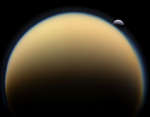 Tethys Behind Titan
27.01.2010
What's that behind Titan? It's another of Saturn's moons: Tethys. The robotic Cassini spacecraft orbiting Saturn captured the heavily cratered Tethys slipping behind Saturn's atmosphere-shrouded Titan late last year. The largest crater on Tethys, Odysseus, is easily visible on the distant moon.
 High Energy Stereoscopic System II
27.07.2012
The largest of its kind, the High Energy Stereoscopic System (H.E.S.S.) II telescope stands in the foreground of this photo. Tilted horizontally it reflects the inverted landscape of the Namibian desert in a segmented mirror 24 meters wide and 32 meters tall, equal in area to two tennis courts.
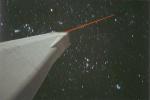 Space Laser Creates Artificial Star
25.04.2001
Some astronomers don't like stars. Bright star fluctuations can indicate how the Earth's atmosphere is changing, but many times no bright star exists in the direction where atmospheric information is needed.
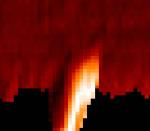 Tornadoes on the Sun
29.04.1998
Giant spinning clouds of gas, similar to Earth's tornadoes, have been found on the Sun. Solar tornadoes, however, can be larger than the entire Earth, and sustain wind gusts over 1000 times stronger than their Earth counterparts.
 Neptune in Infrared
25.10.1999
Neptune has never looked so clear in infrared light. Neptune is the eighth most distant planet from the Sun, thirty times the Earth-Sun distance. Neptune is the fourth largest planet, almost four times Earth's diameter. Surprisingly, Neptune radiates about twice as much energy as it receives from the Sun.
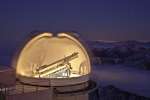 A Glimpse of CLIMSO
25.11.2011
A tantalizing glimpse inside this dome was captured after sunset at the mountain top Pic Du Midi Observatory in the French Pyrenees. But while most are just beginning their work at sunset, this observatory's day was done.
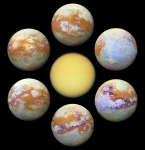 Seeing Titan
18.08.2018
Shrouded in a thick atmosphere, Saturn's largest moon Titan really is hard to see. Small particles suspended in the upper atmosphere cause an almost impenetrable haze, strongly scattering light at visible wavelengths and hiding Titan's surface features from prying eyes.
 APOD: 2025 February 10 Б Auroral Hummingbird over Norway
10.02.2025
Is this the largest hummingbird ever? Although it may look like a popular fluttering nectarivore, what is pictured is actually a beautifully detailed and colorful aurora, complete with rays reminiscent of feathers. This aurora...
|
January February March April May June July August September October |
|||||||||||||||||||||||||||||||||||||||||||||||||