
|
You entered: atmosphere
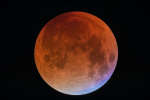 A Blue Blood Moon
3.10.2015
This sharp telescopic snapshot caught late September's Harvest Moon completely immersed in Earth's dark umbral shadow, at the beginning of a total lunar eclipse. It was the final eclipse in a tetrad, a string of four consecutive total lunar eclipses.
 APOD: 2024 December 3 Б Ice Clouds over a Red Planet
3.12.2024
If you could stand on Mars -- what might you see? You might look out over a vast orange landscape covered with rocks under a dusty orange sky, with a blue-tinted Sun setting over the horizon, and odd-shaped water clouds hovering high overhead.
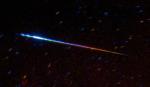 A Perseid Meteor
11.08.1997
Tonight the Perseid Meteor Shower reaches its maximum. Grains of rocky ice will streak across the sky as they evaporate during entry into Earth's atmosphere. These ice chips were shed from Comet Swift-Tuttle. The Perseids result from the annual crossing of the Earth through Comet Swift-Tuttle's orbit.
 APOD: 2025 March 4 Б A Quadruple Alignment over Italy
4.03.2025
Why does this Moon look so unusual? A key reason is its vivid red color. The color is caused by the deflection of blue light by Earth's atmosphere -- the same reason that the daytime sky appears blue. The Moon also appears unusually distorted.
 APOD: 2023 May 9 Б Shadows of Earth
9.05.2023
Can you find two Earth shadows in today's image? It's a bit tricky. To find the first shadow, observe that the top part of the atmosphere appears pink and the lower part appears blue. This is because the top half is exposed to direct sunlight, while the lower part is not.
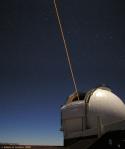 A Telescope Laser Creates an Artificial Star
7.02.2005
What do you get when you combine one of the world's most powerful telescopes with a powerful laser? An artificial star. Monitoring fluctuations in brightness of a genuine bright star can indicate how the Earth's atmosphere is changing, but many times no bright star exists in the direction where atmospheric information is needed.
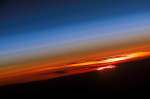 Sunset: Planet Earth
20.03.2008
Today, the Sun crosses the celestial equator heading north at 0548 UT. Known as the equinox, the geocentric astronomical event marks the first day of spring in the northern hemisphere and autumn in the south.
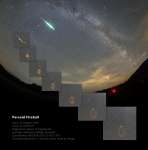 Perseid Fireball and Persistent Train
17.08.2018
Before local midnight on August 12, this brilliant Perseid meteor flashed above the Poloniny Dark Sky Park, Slovakia, planet Earth. Streaking beside the summer Milky Way, its initial color is likely due to the shower meteor's characteristically high speed.
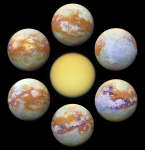 Seeing Titan
20.08.2020
Shrouded in a thick atmosphere, Saturn's largest moon Titan really is hard to see. Small particles suspended in the upper atmosphere cause an almost impenetrable haze, strongly scattering light at visible wavelengths and hiding Titan's surface features from prying eyes.
 APOD: 2025 April 15 Б Planetary Nebula NGC 1514 from Webb
15.04.2025
What happens when a star runs out of nuclear fuel? For stars like our Sun, the center condenses into a white dwarf while the outer atmosphere is expelled into space to appear as a planetary nebula.
|
January February March April May June July August September October |
|||||||||||||||||||||||||||||||||||||||||||||||||