
|
You entered: distance
 NGC 3242: The 'Ghost of Jupiter' Planetary Nebula
31.03.1997
It's a weed, it's Jupiter, no it's - actually planetary nebula NGC 3242. After a star like our Sun completes fusion in its core, it throws off its outer layers it a striking display called a planetary nebula.
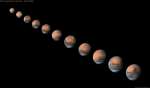 Mars Approach
1.06.2018
Since the distance from Earth to Mars changes drastically as the planets orbit the Sun, Mars' appearance changes dramaticaly. Mars is bright now, and it's getting closer and brighter still as it orbits toward its 2018 opposition and closest approach to Earth in late July.
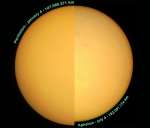 Perihelion and Aphelion
3.07.2009
This year Aphelion, the point in Earth's elliptical orbit when it is farthest from the Sun, occurs tomorrow, July 4th. Of course, that doesn't affect the seasons on our fair planet. Those...
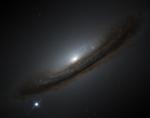 Supernova 1994D and the Unexpected Universe
30.12.1998
Far away, long ago, a star exploded. Supernova 1994D, visible as the bright spot on the lower left, occurred in the outskirts of disk galaxy NGC 4526. Supernova 1994D was not of interest for how different it was, but rather for how similar it was to other supernovae.
 APOD: 2025 January 1 Б Alpha Centauri: The Closest Star System
1.01.2025
The closest star system to the Sun is the Alpha Centauri system. Of the three stars in the system, the dimmest -- called Proxima Centauri -- is actually the nearest star. The bright stars Alpha Centauri...
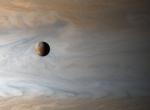 Io: Moon Over Jupiter
20.04.2001
How big is the Jovian moon Io? The most volcanic body in the Solar System, Io (usually pronounced "EYE-oh") is 3,600 kilometers in diameter, about the size of planet Earth's single large natural satellite.
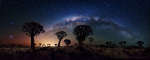 Milky Way Over Quiver Tree Forest
15.05.2016
In front of a famous background of stars and galaxies lies some of Earth's more unusual trees. Known as quiver trees, they are actually succulent aloe plants that can grow to tree-like proportions. The quiver tree name is derived from the historical usefulness of their hollowed branches as dart holders.
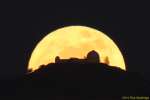 Apogee Full Moon
18.01.2014
This big, bright, beautiful Full Moon rose over Lick Observatory Wednesday night. Traditionally a full moon in January might be called the Wolf Moon. But this moon reached its full phase on January 16, 4:54 UT, within about 2 hours of apogee, the most distant point in its elliptical orbit around planet Earth.
 APOD: 2025 April 7 Б NGC 4414: A Flocculent Spiral Galaxy
7.04.2025
How much mass do flocculent spirals hide? The featured image of flocculent spiral galaxy NGC 4414 was taken with the Hubble Space Telescope to help answer this question. Flocculent spirals -- galaxies without well-defined spiral arms -- are a quite common form of galaxy, and NGC 4414 is one of the closest.
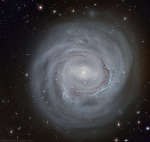 Anemic Spiral NGC 4921 from Hubble
15.05.2019
How far away is spiral galaxy NGC 4921? It's surpringly important to know. Although presently estimated to be about 300 million light years distant, a more precise determination could be coupled with its known recession speed to help humanity better calibrate the expansion rate of the entire visible universe.
|
January February March April May June July August September October |
|||||||||||||||||||||||||||||||||||||||||||||||||