
|
You entered: dust
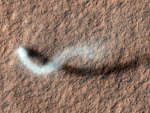 A Dust Devil of Mars
13.04.2012
It was late in the northern martian spring when the HiRISE camera onboard the Mars Reconnaissance Orbiter spied this local denizen. Tracking south and east (down and right) across the flat, dust-covered Amazonis Planitia the core of the whirling dust devil is about 30 meters in diameter.
 Stars, Gas, and Dust Battle in the Carina Nebula
15.08.2017
Chaos reigns in the Carina Nebula where massive stars form and die. Striking and detailed, this close-up of a portion of the famous nebula is a combination of light emitted by hydrogen (shown in red) and oxygen (shown in blue).
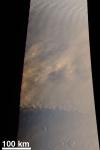 A Martian Dust Storm Approaches
9.08.1999
Batten down the hatches, here comes another Martian dust storm. The thin soil on Mars can be picked up by high winds to create dust storms that sweep down plains and can sometimes envelop most of the planet.
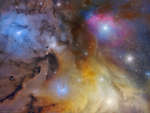 Stars, Dust, and Gas Near Antares
26.01.2022
Why is the sky near Antares and Rho Ophiuchi so dusty yet colorful? The colors result from a mixture of objects and processes. Fine dust -- illuminated from the front by starlight -- produces blue reflection nebulae. Gaseous clouds whose atoms are excited by ultraviolet starlight produce reddish emission nebulae.
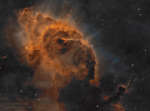 HH 666: Carina Dust Pillar with Jet
6.12.2017
To some, it may look like a beehive harboring an evil bee. In reality, the featured Hubble image captures a cosmic pillar of dust, two-light years long, inside of which is Herbig-Haro 666 -- a young star emitting powerful jets.
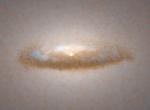 The Doomed Dust Disk of NGC 7052
22.06.1998
What created the dust disk in the center of NGC 7052, and what keeps it spinning? Although the disk might appear as a relatively tame "hubcap in space", the unusual center of elliptical galaxy NGC 7052 is probably the remnant of a titanic collision between galaxies.
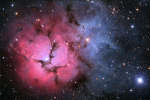 The Trifid Nebula in Stars and Dust
7.07.2009
Unspeakable beauty and unimaginable bedlam can be found together in the Trifid Nebula. Also known as M20, this photogenic nebula is visible with good binoculars towards the constellation of Sagittarius. The energetic processes of star formation create not only the colors but the chaos. The red-glowing gas results from high-energy starlight striking interstellar hydrogen gas.
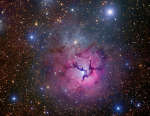 The Trifid Nebula is Stars and Dust
28.07.2010
Unspeakable beauty and unimaginable bedlam can be found together in the Trifid Nebula. Also known as M20, this photogenic nebula is visible with good binoculars towards the constellation of Sagittarius. The energetic processes of star formation create not only the colors but the chaos. The red-glowing gas results from high-energy starlight striking interstellar hydrogen gas.
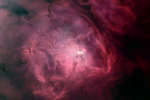 Gas and Dust of the Lagoon Nebula
15.07.2008
This beautiful cosmic cloud is a popular stop on telescopic tours of the constellation Sagittarius. Eighteenth century cosmic tourist Charles Messier cataloged the bright nebula as M8, while modern day astronomers recognize the Lagoon...
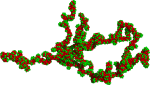 Fractal Interstellar Dust Up Close
9.05.1999
Our universe is a very dusty place. Dust usually shows its presence by blocking out light emitted from stars or nebulae behind it, sometimes creating the illusion of a horse's head or a sombrero hat. But nobody really knows what a typical interstellar dust grain looks like. By
|
January February March April May June July August September October |
|||||||||||||||||||||||||||||||||||||||||||||||||