
|
You entered: dust
 M78 and Reflecting Dust Clouds in Orion
18.03.2008
An eerie blue glow and ominous columns of dark dust highlight M78 and other bright reflection nebula in the constellation of Orion. The dark filamentary dust not only absorbs light, but also reflects the light of several bright blue stars that formed recently in the nebula.
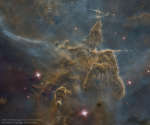 Mystic Mountain Dust Pillars
15.04.2015
It's stars versus dust in the Carina Nebula and the stars are winning. More precisely, the energetic light and winds from massive newly formed stars are evaporating and dispersing the dusty stellar nurseries in which they formed.
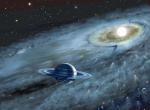 Fomalhaut Dust Disk Indicates Planets
11.10.2002
One of the brightest stars on the sky likely has planets. Fomalhaut, actually the 17th brightest star in the night sky, is a mere 22 light-years away but only a fraction of the age of our Sun.
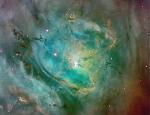 Stars and Dust of the Lagoon Nebula
8.09.2003
The large majestic Lagoon Nebula is home for many young stars and hot gas. Spanning 100 light years across while lying only about 5000 light years distant, the Lagoon Nebulae is so big and bright that it can be seen without a telescope toward the constellation of Sagittarius.
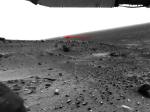 A Dust Devil Swirling on Mars
23.03.2005
What is that wisp on the horizon? Scientists think that the slight white apparition is actually a Martian dust devil that was caught swirling across Mars. The above image was taken earlier this month by the robotic rover Spirit.
 APOD: 2024 December 25 Б Diamond Dust Sky Eye
25.12.2024
Why is there a huge eye in the sky? Diamond dust. That is an informal term for small ice crystals that form in the air and flitter to the ground. Because these crystals...
 APOD: 2023 August 7 Б The Pelican Nebula in Gas, Dust, and Stars
7.08.2023
The Pelican Nebula is slowly being transformed. IC 5070 (the official designation) is divided from the larger North America Nebula by a molecular cloud filled with dark dust. The Pelican, however, receives much study because it is a particularly active mix of star formation and evolving gas clouds.
 Old Planetary Dust Disks Found by SST
19.10.2004
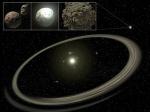
Why are some older stars surrounded by dust? Observations from the Spitzer Space Telescope by a team led by George Rieke (U. Arizona) were expected to show that young stars, on the order of one million years old, have large dust disks, while relatively older stars, between 10 and 100 million years old, have none.
 Dust Storm on Planet Earth
3.03.2000
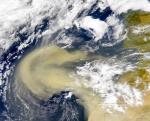
From low Earth orbit, NASA's SeaWIFS instrument records ocean color, tracking changes in our water world's climate and biosphere. But even an ocean planet can have dust storms. On February 26th, SeaWIFS...
 Fractal Interstellar Dust Up Close
6.07.2003
Our universe is a very dusty place. Dust usually shows its presence by blocking out light emitted from stars or nebulae behind it, sometimes creating the illusion of a horse's head or a sombrero hat. But nobody really knows what a typical interstellar dust grain looks like.
|
January February March April May June July August September October |
|||||||||||||||||||||||||||||||||||||||||||||||||