
|
You entered: telescope
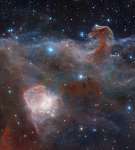 Horsehead: A Wider View
3.05.2013
Combined image data from the massive, ground-based VISTA telescope and the Hubble Space Telescope was used to create this wide perspective of the interstellar landscape surrounding the famous Horsehead Nebula. Captured at near-infrared wavelengths...
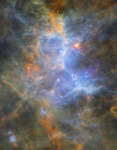 Herschel s Eagle Nebula
27.07.2016
A now famous picture from the Hubble Space Telescope featured Pillars of Creation, star forming columns of cold gas and dust light-years long inside M16, the Eagle Nebula. This false-color composite image views...
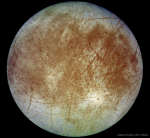 Jupiters Europa from Spacecraft Galileo
26.09.2016
What mysteries might be solved by peering into this crystal ball? In this case, the ball is actually a moon of Jupiter, the crystals are ice, and the moon is not only dirty but cracked beyond repair. Nevertheless, speculation is rampant that oceans exist under Europa's fractured ice-plains that could support life.
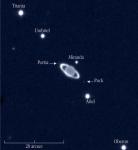 Ringed Planet Uranus
14.01.2003
Yes it does look like Saturn, but Saturn is one of only four giant ringed planets in our Solar System. And while Saturn has the brightest rings, this system of rings and moons actually belongs to planet Uranus, imaged here in near-infrared light by the Antu telescope at the ESO Parnal Observatory in Chile.
 Gamma Ray Moon
27.05.2006
If you could see gamma rays - photons with a million or more times the energy of visible light - the Moon would appear brighter than the Sun! The startling notion is demonstrated by this image...
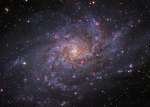 M33: Triangulum Galaxy
20.12.2012
The small, northern constellation Triangulum harbors this magnificent face-on spiral galaxy, M33. Its popular names include the Pinwheel Galaxy or just the Triangulum Galaxy. M33 is over 50,000 light-years in diameter, third largest in the Local Group of galaxies after the Andromeda Galaxy (M31), and our own Milky Way.
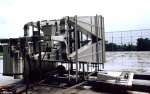 Radio, The Big Ear, and the WOW Signal
1.05.2020
Since the early days of radio and television we have been freely broadcasting signals into space. For some time now, we have been listening too. A large radio telescope at Ohio State University known as affectionately The Big Ear was one of the first listeners.
 APOD: 2023 October 11 Б NGC 1097: Spiral Galaxy with Supernova
10.10.2023
What's happening in the lower arm of this spiral galaxy? A supernova. Last month, supernova SN 2023rve was discovered with UAE's Al-Khatim Observatory and later found to be consistent with the death explosion of a massive star, possibly leaving behind a black hole.
 Pleiades from Planet Earth
31.10.2025
The lovely Pleiades star cluster shines in Earth's night sky, a compact group of stars some 400 light-years distant toward the constellation Taurus and the Orion Arm of our Milky Way galaxy. Recognized since ancient times, the remarkable celestial gathering is visible to the unaided eye.
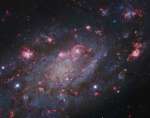 NGC 2403 in Camelopardalis
23.07.2011
Magnificent island universe NGC 2403 stands within the boundaries of the long-necked constellation Camelopardalis. Some 10 million light-years distant and about 50,000 light-years across, the spiral galaxy also seems to have more than its fair share of giant star forming HII regions, marked by the telltale reddish glow of atomic hydrogen gas.
|
January February March April May June July August September October |
|||||||||||||||||||||||||||||||||||||||||||||||||