
|
You entered: telescope
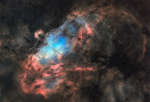 Portrait of the Eagle Nebula
12.08.2022
A star cluster around 2 million years young surrounded by natal clouds of dust and glowing gas, Messier 16 (M16) is also known as The Eagle Nebula. This beautifully detailed image of the region adopts the colorful Hubble palette and includes cosmic sculptures made famous in Hubble Space Telescope close-ups of the starforming complex.
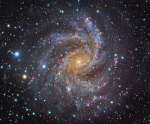 Facing NGC 6946
24.02.2018
From our vantage point in the Milky Way Galaxy, we see NGC 6946 face-on. The big, beautiful spiral galaxy is located just 10 million light-years away, behind a veil of foreground dust and stars in the high and far-off constellation of Cepheus.
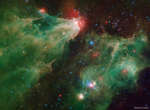 The Cave Nebula in Infrared from Spitzer
11.06.2019
What's happening in and around the Cave Nebula? To help find out, NASA's orbiting Spitzer Space Telescope looked into this optically-dark star-forming region in four colors of infrared light. The Cave Nebula...
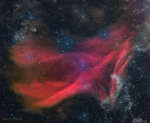 Waves of the Great Lacerta Nebula
14.09.2022
It is one of the largest nebulas on the sky -- why isn't it better known? Roughly the same angular size as the Andromeda Galaxy, the Great Lacerta Nebula can be found toward the constellation of the Lizard (Lacerta).
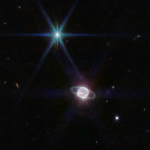 Ringed Ice Giant Neptune
19.08.2023
Ringed ice giant Neptune lies near the center of this sharp near-infrared image from the James Webb Space Telescope. The dim and distant world is the farthest planet from the Sun, about 30 times farther away than planet Earth.
 APOD: 2024 April 1 Б Swirling Magnetic Field around Our Galaxys Central Black Hole
1.04.2024
What's happening to the big black hole in the center of our galaxy? It is sucking in matter from a swirling disk -- a disk that is magnetized, it has now been confirmed. Specifically, the black hole's accretion disk has recently been seen to emit polarized light, radiation frequently associated with a magnetized source.
 Ringed Ice Giant Neptune
6.09.2024
Ringed ice giant Neptune lies near the center of this sharp near-infrared image from the James Webb Space Telescope. The dim and distant world is the farthest planet from the Sun, about 30 times farther away than planet Earth.
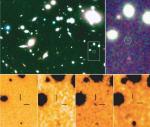 Redshift 10: Evidence for a New Farthest Galaxy
17.03.2004
What's the farthest galaxy known? The answer keeps changing as astronomers compete to find galaxies that top the list. The new claimed record holder is now the faint smudge indicated in the above images by an 8.2-meter Very Large Telescope (VLT) operating in Chile.
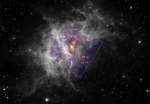 Young Star Cluster Westerlund 2
31.01.2008
Dusty stellar nursery RCW 49 surrounds young star cluster Westerlund 2 in this remarkable composite skyscape from beyond the visible spectrum of light. Infrared data from the Spitzer Space Telescope is shown in black...
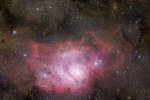 The Lagoon Nebula from GigaGalaxy Zoom
6.10.2009
The large majestic Lagoon Nebula is home for many young stars and hot gas. Spanning 100 light years across while lying only about 5000 light years distant, the Lagoon Nebulae is so big and bright that it can be seen without a telescope toward the constellation of Sagittarius.
|
January February March April May June July August September October |
|||||||||||||||||||||||||||||||||||||||||||||||||