
|
You entered: telescope
 Airglow, Gegenschein, and Milky Way
20.04.2013
As far as the eye could see, it was a dark night at Las Campanas Observatory in the southern Atacama desert of Chile. But near local midnight on April 11, this mosaic of 3 minute long exposures revealed a green, unusually intense, atmospheric airglow stretching over thin clouds.
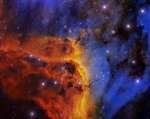 IC 5067 in the Pelican Nebula
26.05.2016
The prominent ridge of emission featured in this sharp, colorful skyscape is cataloged as IC 5067. Part of a larger emission nebula with a distinctive shape, popularly called The Pelican Nebula, the ridge spans about 10 light-years following the curve of the cosmic pelican's head and neck.
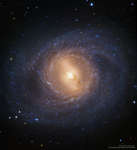 M95: Spiral Galaxy with an Inner Ring
29.05.2019
Why do some spiral galaxies have a ring around the center? First and foremost, M95 is one of the closer examples of a big and beautiful barred spiral galaxy. Visible in the featured combination...
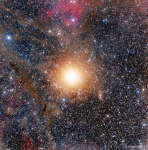 Behind Betelgeuse
11.05.2020
What's behind Betelgeuse? One of the brighter and more unusual stars in the sky, the red supergiant star Betelgeuse can be found in the direction of famous constellation Orion. Betelgeuse, however, is actually...
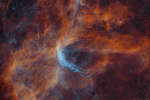 APOD: 2026 May 22 Б The Nebulous Realm of WR 134
22.05.2026
This cosmic snapshot covers a field of view over twice as wide as the full Moon within the boundaries of the high-flying constellation Cygnus. Made using astronomical narrowband filters, the image highlights the bright edge of a ring-like nebula traced by the glow of ionized hydrogen and oxygen gas.
 A High Energy Fleet
24.05.1998
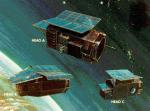
Looking like a fleet of futuristic starcruisers, NASA's highly successful series of High Energy Astrophysical Observatory (HEAO) spacecraft appear poised over planet Earth. Labeled A, B, and C in this vintage illustration, the spacebased telescopes were known as HEAO-1, HEAO-2, and HEAO-3 respectively.
 UKIRT: Aloha Orion
6.01.2005
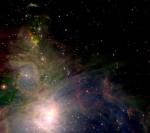
At the edge of a dense molecular cloud, filaments of gas, cosmic dust, and a multitude of young stars beckon in this penetrating image of the Orion Nebula. Alluring structures in the well-known star...
 The Hubble Extreme Deep Field
14.10.2012
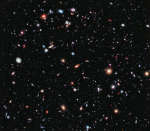
What did the first galaxies look like? To help answer this question, the Hubble Space Telescope has just finished taking the eXtreme Deep Field (XDF), the deepest image of the universe ever taken in visible light.
 M51: The Whirlpool Galaxy in Dust and Stars
24.02.2013
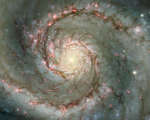
The Whirlpool Galaxy is a classic spiral galaxy. At only 30 million light years distant and fully 60 thousand light years across, M51, also known as NGC 5194, is one of the brightest and most picturesque galaxies on the sky.
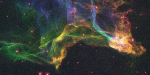 Cygnus Loop Supernova Shockwave
18.07.1995
15,000 years ago a star in the constellation of Cygnus exploded. This picture shows a portion of a shockwave from this supernova explosion still expanding past nearby stars. The collision of this gaseous...
|
January February March April May June July August September October |
|||||||||||||||||||||||||||||||||||||||||||||||||