
|
You entered: time
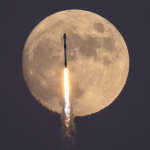 The Falcon and the Hunter s Moon
14.10.2022
The Full Moon of October 9th was the second Full Moon after the northern hemisphere autumnal equinox, traditionally called the Hunter's Moon. According to lore, the name is a fitting one because this Full Moon lights the night during a time for hunting in preparation for the coming winter months.
 Oceans Under Jupiter's Europa?
9.04.1997
Is there life beneath Europa? Today, new results are being announced (at about 2 pm EST) about the possibility of oceans under Jupiter's moon Europa. The existence of such oceans increases the likelihood that some sort of life exists beneath the fractured ice planes of Jupiter's smoothest satellite.
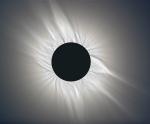 The Crown of the Sun
7.04.2006
During a total solar eclipse, the Sun's extensive outer atmosphere or corona is an awesome and inspirational sight. The subtle shades and shimmering features of the corona that engage the eye span a brightness range of over 10,000 to 1, making them notoriously difficult to capture in a single picture.
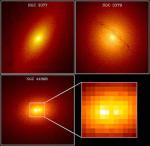 Black Holes in Galactic Centers
17.10.1999
Do all galaxies have black holes at their centers? Although not even a single galaxy has yet been proven to have a central black hole, the list of candidates continues to increase. Results...
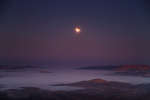 Eclipse at Moonset
9.10.2014
The Pacific Ocean and Chilean coast lie below this sea of clouds. Seen through the subtle colors of the predawn sky a lunar eclipse is in progress above, the partially eclipsed Moon growing dark.
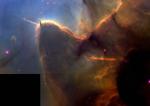 Starbirth in the Trifid Nebula
7.06.1999
Tremendous pillars of gas and dust are being boiled away in the Trifid Nebula. In the center of the picturesque Trifid lies a young hot star, located above and to the right of this picture. As soon as it was born, the massive star scorched its surroundings with bright and
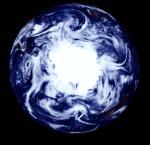 Summer at the South Pole
23.12.2000
The December solstice brings the beginning of Winter to Earth's Northern Hemisphere and Summer time to the South! This view of Earth's Southern Hemisphere near the beginning of Summer was created using images from the Galileo spacecraft taken during its December 1990 flyby of our fair planet.
 The Universe Evolves
30.06.1998
Scroll right and watch the universe evolve. Above is a computer simulation depicting the evolution of our entire universe. On the far left is a slice of the universe soon after the Big Bang - over 10 billion years ago.
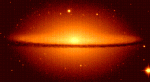 M104: The Sombrero Galaxy
9.11.1995
The famous Sombrero galaxy (M104) is a bright nearby spiral galaxy. The prominent dust lane and halo of stars and globular clusters give this galaxy its name. Something very energetic is going on in the Sombrero's center, as much X-ray light has been detected from it.
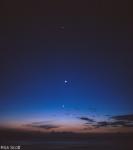 March of the Planets
25.03.1999
This March stargazers have been treated to eye-catching formations of bright planets in western evening skies. On March 3rd, looking toward a beautiful sunset from a beach on the Hawaiian isle of Maui, photographer Rick Scott recorded this fleeting, four-planet "hockey stick" array.
|
January February March April May June July August |
||||||||||||||||||||||||||||||||||||||||||||||||||||||||