
|
You entered: time
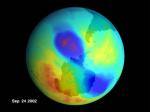 A Small Double Ozone Hole in 2002
22.10.2002
As expected, the ozone hole near Earth's South Pole is back again this year. This time, however, it's smaller than the past two years, and has an unusual double lobe structure. Ozone is important because it shields us from damaging ultraviolet sunlight.
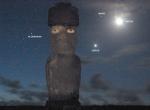 Planets Over Easter Island
24.05.2004
It isn't every day that planets line up behind a stone giant. For one thing, it helps to have a good planet line-up, such as occurred in the sky just last month. For another, it helps to be on Easter Island, where over 800 large stone statues exist.
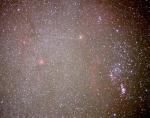 Meteor Milky Way
26.11.1998
The bold, bright star patterns of Orion (right) are a familiar sight to even casual skygazers. But this gorgeous color photo also features a subtler spectacle - the faint stars of the Milky Way.
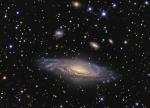 NGC 7331 and Beyond
27.07.2006
Spiral galaxy NGC 7331 is often touted as an analog to our own Milky Way. About 50 million light-years distant in the northern constellation Pegasus, NGC 7331 was recognized early on as a spiral nebula and is actually one of the brighter galaxies not included in Charles Messier's famous 18th century catalog.
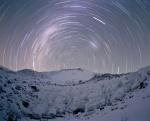 Star Trails at 19 000 Feet
2.12.2006
In myth, Atlas holds up the heavens, but in this stunning view a mountain appears to serve as the southern night sky pivots around a snowy peak. Recorded during a climbing expedition...
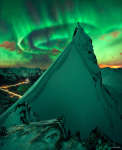 In Green Company: Aurora over Norway
9.11.2020
Raise your arms if you see an aurora. With those instructions, two nights went by with, well, clouds -- mostly. On the third night of returning to same peaks, though, the sky not only cleared up but lit up with a spectacular auroral display.
 Solar Analemma 2024
2.01.2025
Recorded during 2024, this year-spanning series of images reveals a pattern in the seasonal drift of the Sun's daily motion through planet Earth's sky. Known to some as an analemma, the figure-eight curve was captured in exposures taken only at 1pm local time on clear days from Kayseri, Turkiye.
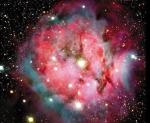 IC 5146: The Cocoon Nebula
14.10.2002
How did this nebula get created? The Cocoon Nebula, cataloged as IC 5146, is a strikingly beautiful nebula located about 4,000 light years away toward the constellation of Cygnus. Inside the Cocoon is a newly developing open cluster of stars.
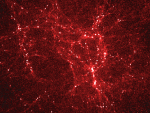 The Early Universe
14.06.1997
What did our universe look like when it was young? To answer this, cosmologists run sophisticated computer programs tracking the locations of millions of particles. The above animated frame is the result of such a calculation and shows how our universe might have looked when it was just a fracton of its current age.
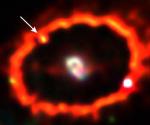 Shocked by Supernova 1987a
17.02.1998
Eleven years ago the brightest supernova of modern times was recorded. Now the expanding debris from this tremendous stellar explosion is seen to be crashing into previously expelled material. The onset of this collision is shown by the arrow in the above picture as the yellow spot on the interior of the ring.
|
January February March April May June July August |
||||||||||||||||||||||||||||||||||||||||||||||||||||||||