
|
You entered: distance
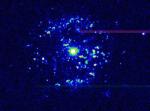 T Pyxidis: Recurrent Nova
25.09.1997
What happens when a thermonuclear blast occurs on the surface of a white dwarf star? Over the years astronomers have watched (at a safe distance ...) as, 6,000 light years from Earth in the southern constellation Pyxis, a binary star known as T Pyxidis repeatedly produces these fearsome explosions.
 The Tarantula Nebula
6.01.2006
First cataloged as a star, 30 Doradus is actually an immense star forming region in nearby galaxy The Large Magellanic Cloud. The region's spidery appearance is responsible for its popular name, the Tarantula Nebula, except that this tarantula is about 1,000 light-years across, and 180,000 light-years away in the southern constellation Dorado.
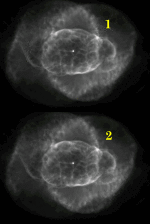 The Incredible Expanding Cats Eye
16.09.1999
Watch closely. As this animation blinks between two Hubble Space Telescope images of NGC 6543 - the first from 1994 and the second from 1997 - the intricate filaments of this nebula are seen to shift. The shift is due to the actual expansion of this gaseous shroud shed by a dying star!
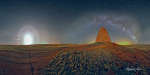 Geometers Playground Over Wyoming
6.06.2011
If you travel several kilometers off a main highway through Wyoming, you may see an unusual sight. In particular, near Buford, Wyoming, USA, you could run across the geometric Ames Monument, visible on the right, built to commemorate the financiers of a historic transcontinental railroad across North America.
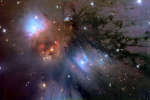 NGC 2170: Still Life with Reflecting Dust
7.07.2013
In this beautiful celestial still life composed with a cosmic brush, dusty nebula NGC 2170 shines at the upper left. Reflecting the light of nearby hot stars, NGC 2170 is joined by other bluish reflection nebulae, a compact red emission region, and streamers of obscuring dust against a backdrop of stars.
 Virtual Flyby of the Whirlpool Galaxy
6.05.2019
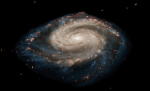
What would it look like to fly over a spiral galaxy? To help visualize this, astronomers and animators at the Space Telescope Science Institute computed a virtual flyby of the Whirlpool Galaxy (M51) using data and images from the Hubble Space Telescope.
 Messier 81
27.03.2025
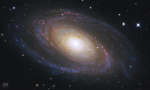
One of the brightest galaxies in planet Earth's sky is similar in size to our Milky Way Galaxy: big, beautiful Messier 81. Also known as NGC 3031 or Bode's galaxy for its 18th century discoverer, this grand spiral can be found toward the northern constellation of Ursa Major, the Great Bear.
 Bright Venus
8.03.2001
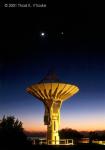
Have you seen a bright evening star in the western sky lately? That's no star, that's planet Venus the second "rock" from the Sun. Blazing at -4.6 magnitude, Venus, after the Sun and Moon, is the third brightest celestial body in planet Earth's sky.
 The Red Spider Planetary Nebula
24.07.2001
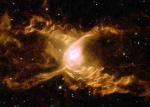
Oh what a tangled web a planetary nebula can weave. The Red Spider Planetary Nebula shows the complex structure that can result when a normal star ejects its outer gases and becomes a white dwarf star.
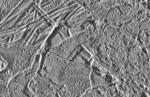 Europa: The Latest From Galileo
17.01.1997
Today, NASA revealed recent results from the Galileo Probe's December 19th flyby of Europa, Jupiter's ice-covered moon - including this close-up image of fractured and frozen terrrain. The highest resolution picture ever made...
|
January February March April May June July August September October |
|||||||||||||||||||||||||||||||||||||||||||||||||