
|
You entered: distance
 Asteroid Donaldjohanson
25.04.2025
Main belt asteroid 52246 Donaldjohanson is about 8 kilometers long and 3.5 kilometers across. On April 20, this sharp close-up of the asteroid was captured at a distance of about 1100 kilometers by the Lucy spacecraft's long range camera during its second asteroid encounter.
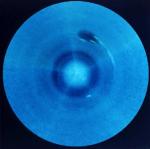 Southern Neptune
29.05.1997
Neptune, the Solar System's outermost gas giant planet, is 30 times farther from the Sun than Earth. Twelve years after a 1977 launch, Voyager 2 flew by Neptune and found surprising activity on a planet that receives only 3 percent as much sunlight as Jupiter.
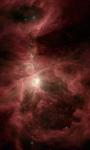 Spitzer s Orion
18.08.2006
Few cosmic vistas excite the imagination like the Orion Nebula, an immense stellar nursery some 1,500 light-years away. Also known as M42, the nebula is visible to the unaided eye, but this stunning...
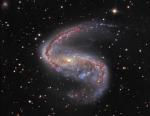 NGC 2442: Galaxy in Volans
15.03.2007
Distorted galaxy NGC 2442 can be found in the southern constellation of the flying fish, (Piscis) Volans. Located about 50 million light-years away, the galaxy's two spiral arms extending from a pronounced central bar give it an ominous hook-shaped appearance.
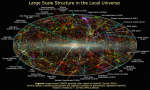 The Universe Nearby
11.12.2007
What does the universe nearby look like? This plot shows over one and a half million of the brightest stars and galaxies in the nearby universe detected by the Two Micron All Sky Survey (2MASS) in infrared light.
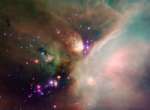 Young Stars in the Rho Ophiuchi Cloud
15.02.2008
Cosmic dust clouds and embedded newborn stars glow at infrared wavelengths in this tantalizing false-color view from the Spitzer Space Telescope. Pictured is of one of the closest star forming regions, part of the Rho Ophiuchi cloud complex some 400 light-years distant near the southern edge of the pronounceable constellation Ophiuchus.
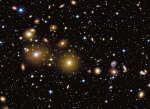 The Perseus Cluster of Galaxies
20.05.2008
Here is one of the largest objects that anyone will ever see on the sky. Each of these fuzzy blobs is a galaxy, together making up the Perseus Cluster, one of the closest clusters of galaxies. The cluster is seen through a foreground of faint stars in our own Milky Way Galaxy.
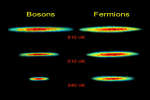 Pauli Exclusion Principle: Why You Don't Implode
28.02.2010
Why doesn't matter just bunch up? The same principle that keeps neutron stars and white dwarf stars from imploding also keeps people from imploding and makes normal matter mostly empty space. The observed reason is known as the Pauli Exclusion Principle.
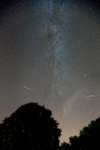 Night of the Perseids
14.08.2010
On the night of August 12, from moonset until dawn was a good time to see meteors. Enthusiasts watched as comet dust rained on planet Earth, streaking through dark skies during the annual Perseid Meteor Shower.
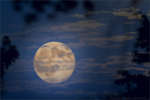 Surreal Moon
14.08.2014
Big, bright, and beautiful, a Full Moon near perigee, the closest point in its elliptical orbit around our fair planet, rose on August 10. This remarkable picture records the scene with a dreamlike quality from the east coast of the United States.
|
January February March April May June July August September October |
|||||||||||||||||||||||||||||||||||||||||||||||||