
|
You entered: distance
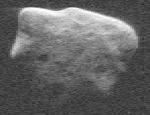 1999 JM8: A Rock Too Close
1.09.1999
Nearly four kilometers across, the huge rock known as 1999 JM8 silently passed only 8.5 million kilometers from the Earth in early August. The small asteroid was completely unknown before May. Every few centuries, a rock like this impacts the Earth, with the potential to disrupt modern civilization.
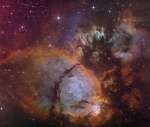 The Colors of IC 1795
10.12.2009
This colorful cosmic portrait features glowing gas and dark dust clouds in IC 1795, a star forming region in the northern constellation Cassiopeia. The nebula's colors were created by adopting the Hubble false-color...
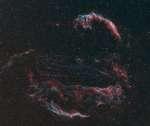 The Veil Nebula
16.09.2010
Delicate in appearance, these filaments of shocked, glowing gas, draped in planet Earth's sky toward the constellation of Cygnus, make up the Veil Nebula. The nebula is a large supernova remnant, an expanding cloud born of the death explosion of a massive star.
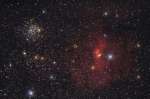 The Bubble and M52
14.09.2011
To the eye, this cosmic composition nicely balances the Bubble Nebula at the lower right with open star cluster M52. The pair would be lopsided on other scales, though. Embedded in a complex...
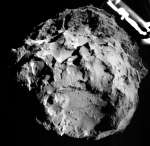 Descent to a Comet
12.11.2014
Yesterday, the first soft landing on a comet took place some 500 million kilometers from planet Earth as the Rosetta mission lander Philae settled on the nucleus of C67/P Churyumov-Gerasimenko. The landing site, dubbed Agilkia, is located near the center of this remarkable image snapped by Philae's ROLIS (ROsetta Lander Imaging System) camera.
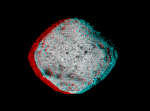 3D Bennu
13.12.2018
Put on your red/blue glasses and float next to asteroid 101955 Bennu. Shaped like a spinning top toy with boulders littering its rough surface, the tiny Solar System world is about 1 Empire State Building (less than 500 meters) across.
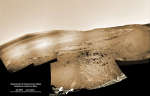 Opportunity at Perseverance Valley
15.02.2019
Opportunity had already reached Perseverance Valley by June of 2018. Its view is reconstructed in a colorized mosaic of images taken by the Mars Exploration Rover's Navcam. In fact, Perseverance Valley is an appropriate name for the destination.
 Mars Perseverance Sol 3
26.02.2021
Stitched together on planet Earth, 142 separate images make up this 360 degree panorama from the floor of Jezero Crater on Mars. The high-resolution color images were taken by the Perseverance rover's zoomable Mastcam-Z during mission sol 3, also known as February 21, 2021.
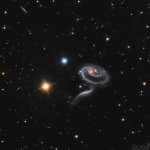 Peculiar Galaxies of Arp 273
19.02.2022
The spiky stars in the foreground of this backyard telescopic frame are well within our own Milky Way Galaxy. But the two eye-catching galaxies lie far beyond the Milky Way, at a distance of over 300 million light-years. Their distorted appearance is due to gravitational tides as the pair engage in close encounters.
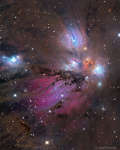 APOD: 2026 May 19 Б NGC 2170: The Angel Nebula
19.05.2026
Is this a painting or a photograph? In this celestial abstract art composed with a cosmic brush, dusty nebula NGC 2170, also known as the Angel Nebula, shines just above the image center. Reflecting...
|
January February March April May June July August September October |
|||||||||||||||||||||||||||||||||||||||||||||||||