
|
You entered: distance
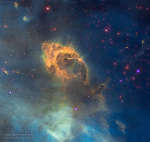 HH 666: Carina Dust Pillar with Jet
13.12.2021
To some, it may look like a beehive. In reality, the featured image from the Hubble Space Telescope captures a cosmic pillar of dust, over two-light years long, inside of which is Herbig-Haro 666 -- a young star emitting powerful jets.
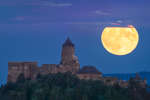 Lubovna Full Moon
14.07.2022
On July 13 this well-planned telephoto view recorded a Full Moon rising over Lubovna Castle in eastern Slovakia. The photographer was about 3 kilometers from the castle walls and about 357,000 kilometers from this Full Moon near perigee, the closest point in its elliptical orbit.
 APOD: 2025 February 2 Б Comet G3 ATLAS Disintegrates
1.02.2025
What's happening to Comet G3 ATLAS? After passing near the Sun in mid-January, the head of the comet has become dimmer and dimmer. By late January, Comet C/2024 G3 (ATLAS) had become a headless wonder -- even though it continued to show impressive tails after sunset in the skies of Earth's Southern Hemisphere.
 APOD: 2025 September 16 Б New Comet SWAN25B over Mexico
15.09.2025
A newly discovered comet is already visible with binoculars. The comet, C/2025 R2 (SWAN) and nicknamed SWAN25B, is brightening significantly as it emerges from the Sun's direction and might soon become visible on your smartphone -- if not your eyes.
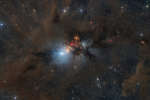 NGC 1333: Stellar Nursery in Perseus
29.01.2026
NGC 1333 is seen in visible light as a reflection nebula, dominated by bluish hues characteristic of starlight reflected by interstellar dust. A mere 1,000 light-years distant toward the heroic constellation Perseus, it lies at the edge of a large, star-forming molecular cloud.
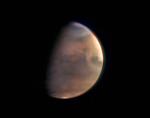 Express to Mars
17.12.2003
Hurtling toward its destination, the high resolution camera on board ESA's Mars Express spacecraft recorded this tantalizing view of the Red Planet earlier this month on December 3rd. Seen from a distance of 5.5 million kilometers, features across part of Mars' western hemisphere are bathed in sunlight.
 V838 Mon: Light Echo Update
3.02.2005
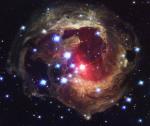
Expanding light echoes continue to illuminate the dusty environs of V838 Monocerotis, mysterious variable star near the edge of our Galaxy. This stunning image, produced from Hubble data recorded in October of 2004, adds to a unique series of space-based, high-resolution views.
 IC 4592: A Blue Horsehead
21.05.2009
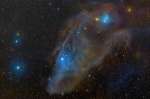
This complex of beautiful, dusty reflection nebulae lies in the constellation Scorpius along the plane of our Milky Way Galaxy. Its overall outline suggests a horsehead in profile, though it covers a much larger region than the better known Horsehead Nebula of Orion.
 Star Factory Messier 17
30.06.2011
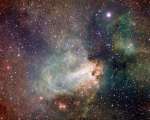
Sculpted by stellar winds and radiation, the star factory known as Messier 17 lies some 5,500 light-years away in the nebula-rich constellation Sagittarius. At that distance, this degree wide field of view spans almost 100 light-years, courtesy of ESO's new VLT Survey Telescope and OmegaCAM.
 M13: The Great Globular Cluster in Hercules
14.06.2012
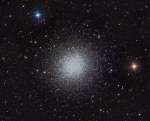
In 1716, English astronomer Edmond Halley noted, "This is but a little Patch, but it shews itself to the naked Eye, when the Sky is serene and the Moon absent." Of course, M13 is now modestly recognized as the Great Globular Cluster in Hercules, one of the brightest globular star clusters in the northern sky.
|
January February March April May June July August September October |
|||||||||||||||||||||||||||||||||||||||||||||||||