
|
You entered: distance
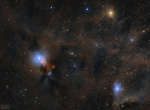 Stardust in the Perseus Molecular cloud
13.01.2017
Clouds of stardust drift through this deep skyscape. The cosmic scene spans nearly 2 degrees across the Perseus molecular cloud some 850 light-years away. A triangle of dusty nebulae reflecting light from embedded stars is captured in the telescopic field of view.
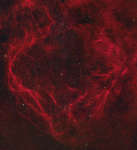 RCW 114: A Dragon s Heart in Ara
10.01.2018
Large and dramatically shaped, this cosmic cloud spans nearly 7 degrees or 14 full moons across planet Earth's sky toward the southern constellation Ara. Difficult to image, the filamentary apparition is cataloged as RCW 114 and traced in this telescopic mosaic by the telltale reddish emission of ionized hydrogen atoms.
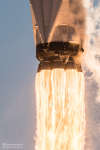 TESS Launch Close Up
20.04.2018
NASA's Transiting Exoplanet Survey Satellite (TESS) began its search for planets orbiting other stars by leaving planet Earth on April 18. The exoplanet hunter rode to orbit on top of a Falcon 9 rocket.
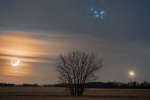 A Cosmic Triangle
14.04.2020
It was an astronomical triple play. Setting on the left, just after sunset near the end of last month, was our Moon -- showing a bright crescent phase. Setting on the right was Venus, the brightest planet in the evening sky last month -- and this month, too.
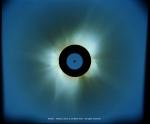 The Crown of the Sun
12.12.2002
During a total solar eclipse, the Sun's extensive outer atmosphere or corona is an awesome and inspirational sight. Yet the subtle shades and shimmering features of the corona that engage the eye span a brightness range of over 10,000 to 1, making them notoriously difficult to capture in a photograph.
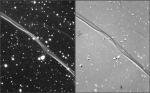 SN 1006: Historys Brightest Supernova
16.03.2003
Suddenly, in the year 1006 AD, a new star appeared in the sky. Over the course of just a few days, the rogue star became brighter than the planet Venus. The star, likely...
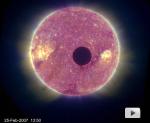 Lunar Transit from STEREO
2.03.2007
A million miles from planet Earth, last weekend the STEREO B spacecraft found itself in the shadow of the Moon. So, looking toward the Sun, extreme ultraviolet cameras onboard STEREO B were able to record a stunning movie of a lunar transit (aka solar eclipse), as the Moon tracked across the solar disk.
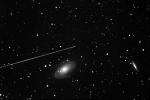 Asteroid and Galaxy
5.04.2007
Apollo class asteroid 2006 VV2 flashed past planet Earth in late March, approaching to within 3.4 million kilometers or about 8.8 times the Earth-Moon distance. Due to the proximity of its orbit to Earth and its estimated diameter of over 1 kilometer, 2006 VV2 is classified as a Potentially Hazardous Asteroid.
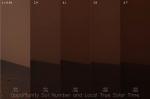 Global Dust Storms Threaten Mars Rovers
25.07.2007
Will global dust storms terminate the robotic Martian rovers? Over the past month, windy dust storms have blocked much needed sunlight from reaching the solar panels of both the Spirit and Opportunity rovers exploring Mars.
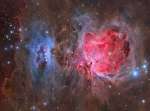 Great Orion Nebulae
23.10.2008
The Great Nebula in Orion, also known as M42, is one of the most famous nebulae in the sky. The star forming region's glowing gas clouds and hot young stars...
|
January February March April May June July August September October |
|||||||||||||||||||||||||||||||||||||||||||||||||