
|
You entered: image
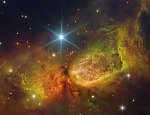 Star Forming Region S106
7.11.2011
Massive star IRS 4 is beginning to spread its wings. Born only about 100,000 years ago, material streaming out from this newborn star has formed the nebula dubbed Sharpless 2-106 Nebula (S106), pictured above.
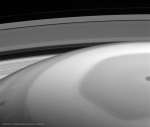 Cassini Looks Out from Saturn
23.12.2022
This is what Saturn looks like from inside the rings. In 2017, for the first time, NASA directed the Cassini spacecraft to swoop between Saturn and its rings. During the dive, the robotic spacecraft took hundreds of images showing unprecedented detail for structures in Saturn's atmosphere.
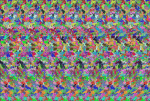 The Holographic Principle
30.01.2005
Is this image worth a thousand words? According to the Holographic Principle, the most information you can get from this image is about 3 x 10 65 bits for a normal sized computer monitor.
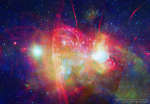 The Galactic Center from Radio to X ray
31.03.2020
In how many ways does the center of our Galaxy glow? This enigmatic region, about 26,000 light years away toward the constellation of the Archer (Sagittarius), glows in every type of light that we can see.
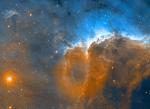 Pelican Nebula Ionization Front
13.10.2003
What's happening to the Pelican Nebula? The light from young energetic stars is slowly transforming the Pelican's cold gas to hot gas, with the advancing boundary between the two known as an ionization front.
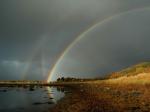 Six Rainbows Across Norway
12.09.2007
Have you ever seen six rainbows at once? They are not only rare to see -- they are a puzzle to understand. The common rainbow is caused by sunlight internally reflected by the backs of falling raindrops, while also being refracted at the air / water boundary.
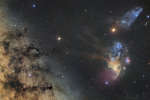 Saturn and Mars visit Milky Way Star Clouds
10.05.2016
Planets, stars, nebulas and a galaxy -- this impressive image has them all. Closest to home are the two planets Mars (right) and Saturn (center), visible as the two bright orange spots in the upper half of the featured image.
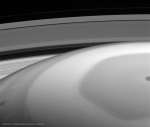 Cassini Looks Out from Saturn
30.04.2017
This is what Saturn looks like from inside the rings. Last week, for the first time, NASA directed the Cassini spacecraft to swoop between Saturn and its rings. During the dive, the robotic spacecraft took hundreds of images showing unprecedented detail for structures in Saturn's atmosphere.
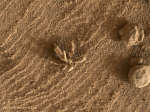 A Flower Shaped Rock on Mars
9.03.2022
It is one of the more unusual rocks yet found on Mars. Smaller than a penny, the rock has several appendages that make it look, to some, like a flower. Although it would...
 APOD: 2023 May 1 Б Carina Nebula North
1.05.2023
The Great Carina Nebula is home to strange stars and iconic nebulas. Named for its home constellation, the huge star-forming region is larger and brighter than the Great Orion Nebula but less well known because it is so far south -- and because so much of humanity lives so far north.
|
January February March April May June July August September |
|||||||||||||||||||||||||||||||||||||||||||||||||