
|
You entered: image
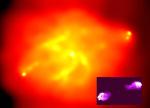 X Ray Cygnus A
9.11.2000
Amazingly detailed, this false-color x-ray image is centered on the galaxy Cygnus A. Recorded by the orbiting Chandra Observatory, Cygnus A is seen here as a spectacular high energy x-ray source. But it is actually more famous at the low energy end of the electromagnetic spectrum as one of the brightest celestial radio sources.
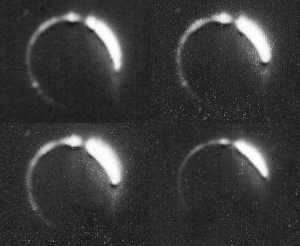 A Solar Eclipse from the Moon
7.04.2014
Has a solar eclipse ever been seen from the Moon? Yes, first in 1967 -- but it may happen again next week. The robotic Surveyor 3 mission took thousands of wide angle television images of the Earth in 1967, a few of which captured the Earth moving in front of the Sun.
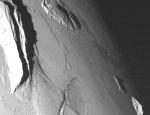 Io at Sunset
19.01.2003
How tall are mountains on Jupiter's moon Io? One way to find out is to view them at sunset. Tall structures facing the Sun are then better-lit and cast long shadows. The above...
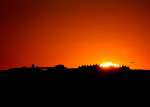 DIA Sunrise
13.11.2009
What's 93 million miles away and still hurts your eyes when you look at it? The answer is not the Denver International Airport, known to some travelers as DIA. But DIA does appear in dramatic silhouette in the foreground of this telephoto image.
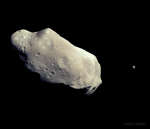 Ida and Dactyl: Asteroid and Moon
16.10.2025
This asteroid has a moon. The robot spacecraft Galileo enroute to explore the Jovian system in 1993, encountered and photographed two asteroids during its long interplanetary voyage. The second minor planet it photographed, 243 Ida, was discovered to have a moon.
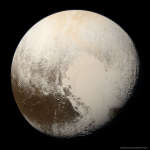 Pluto in True Color
9.09.2019
What color is Pluto, really? It took some effort to figure out. Even given all of the images sent back to Earth when the robotic New Horizons spacecraft sped past Pluto in 2015, processing these multi-spectral frames to approximate what the human eye would see was challenging.
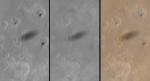 The Shadow of Phobos
28.03.2003
Hurtling through space above the Red Planet, potato-shaped Phobos completes an orbit of Mars in less than eight hours. In fact, since its orbital period is shorter than the planet's rotation period, Mars-based...
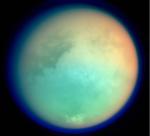 Tantalizing Titan
28.10.2004
Normally hidden by a thick, hazy atmosphere, tantalizing features on Titan's surface appear in this false-color view. The image was recorded as the Cassini spacecraft approached its first close flyby of Saturn's smog-shrouded moon on October 26.
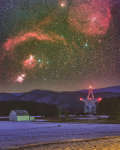 Orion over Green Bank
22.02.2022
What will the huge Green Bank Telescope discover tonight? Pictured, the Robert C. Byrd Green Bank Telescope (GBT) on the lower right is the largest fully-pointable single-dish radio telescope in the world. With...
 Stereo Jupiter near Opposition
4.12.2024
Jupiter looks sharp in these two rooftop telescope images. Both were captured last year on November 17 from Singapore, planet Earth, about two weeks after Jupiter's 2023 opposition. Climbing high in midnight skies the giant planet was a mere 33.4 light-minutes from Singapore. That's about 4 astronomical units away.
|
January February March April May June July August September |
|||||||||||||||||||||||||||||||||||||||||||||||||