
|
You entered: background
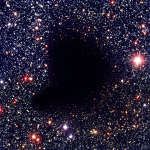 Dark Molecular Cloud Barnard 68
8.10.2017
Where did all the stars go? What used to be considered a hole in the sky is now known to astronomers as a dark molecular cloud. Here, a high concentration of dust and molecular gas absorb practically all the visible light emitted from background stars.
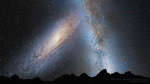 Milky Way Galaxy Doomed: Collision with Andromeda Pending
6.06.2022
Will our Milky Way Galaxy collide one day with its larger neighbor, the Andromeda Galaxy? Most likely, yes. Careful plotting of slight displacements of M31's stars relative to background galaxies on recent Hubble...
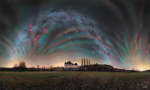 APOD: 2023 February 15 Б Airglow Sky over France
15.02.2023
This unusual sky was both familiar and unfamiliar. The photographer's mission was to capture the arch of the familiar central band of our Milky Way Galaxy over a picturesque medieval manor. The surprise was that on this January evening, the foreground sky was found glowing in a beautiful but unfamiliar manner.
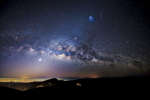 Rocket, Meteor, and Milky Way over Thailand
12.02.2014
Can the night sky appear both serene and surreal? Perhaps classifiable as serene in the above panoramic image taken last Friday are the faint lights of small towns glowing across a dark foreground landscape of Doi Inthanon National Park in Thailand, as well as the numerous stars glowing across a dark background starscape.
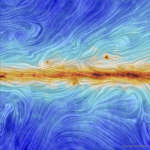 Our Galaxys Magnetic Field from Planck
26.01.2015
What does the magnetic field of our Galaxy look like? It has long been known that a modest magnetic field pervades our Milky Way Galaxy because it is seen to align small dust grains that scatter background light. Only recently, however, has the Earth-orbiting Planck satellite made a high-resolution map of this field.
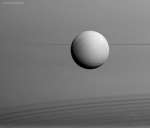 Dione, Rings, Shadows, Saturn
24.08.2015
What's happening in this strange juxtaposition of moon and planet? First and foremost, Saturn's moon Dione was captured here in a dramatic panorama by the robotic Cassini spacecraft currently orbiting the giant planet. The bright and cratered moon itself spans about 1100-km, with the large multi-ringed crater Evander visible on the lower right.
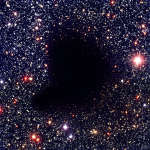 Dark Molecular Cloud Barnard 68
22.11.2020
Where did all the stars go? What used to be considered a hole in the sky is now known to astronomers as a dark molecular cloud. Here, a high concentration of dust and molecular gas absorb practically all the visible light emitted from background stars.
 XMM Launched
21.12.1999
X-ray astronomy entered a golden age earlier this month with the successful launch of the X-ray Multi-Mirror (XMM) satellite. XMM's three huge telescope barrels each hold 58 concentric cylindrical mirrors, together totaling a surface area rivaling a tennis court.
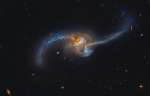 Merging NGC 2623
19.10.2012
NGC 2623 is really two galaxies that are becoming one. Seen to be in the final stages of a titanic galaxy merger, the pair lies some 300 million light-years distant toward the constellation Cancer.
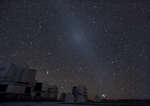 The Gegenschein Over Chile
2.12.2012
Is the night sky darkest in the direction opposite the Sun? No. In fact, a rarely discernable faint glow known as the gegenschein (German for "counter glow") can be seen 180 degrees around from the Sun in an extremely dark sky. The gegenschein is sunlight back-scattered off small interplanetary dust particles.
|
January February March April May June July August September |
|||||||||||||||||||||||||||||||||||||||||||||||||