
|
You entered: rings
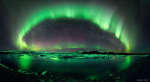 A Starry Night of Iceland
3.01.2016
On some nights, the sky is the best show in town. On this night, the sky was not only the best show in town, but a composite image of the sky won an international competition for landscape astrophotography. The featured winning image was taken in 2011 over JЖkulsАrlСn, the largest glacial lake in Iceland.
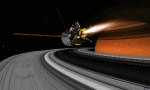 Cassini To Saturn
29.08.1997
Scheduled for launch in October, the Cassini spacecraft will spend seven years traveling through the Solar System -- its destination, Saturn. On arrival Cassini will begin an ambitious mission of exploration which will include parachuting a probe to the surface of Titan, Saturn's largest moon.
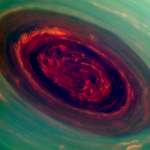 Saturn Hurricane
2.05.2013
Acquiring its first sunlit views of far northern Saturn late last year, the Cassini spacecraft's narrow-angle camera recorded this stunning image of the vortex at the ringed planet's north pole. The false...
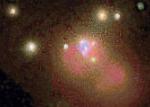 The Center of the Circinus Galaxy in X Rays
16.05.2001
Are black holes the cause of X-rays that pour out from the center of the Circinus galaxy? A new high-resolution image from the orbiting Chandra X-ray Observatory has resolved the inner regions of this nearby galaxy into several smaller sources. The image is shown above in representative-color.
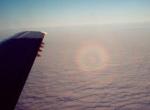 The Glory
17.04.2002
Looking out the window of an airplane, you might be lucky enough to see "the glory" in the direction directly opposite the Sun. Before airplanes, the phenomenon, known to some as the heiligenschein or the Specter of the Brocken, was sometimes seen from mountaintops.
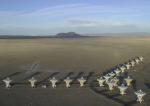 The Very Large Array of Radio Telescopes
14.05.2006
The most photogenic array of radio telescopes in the world has also been one of the most productive. Each of the 27 radio telescopes in the Very Large Array (VLA) is the size of a house and can be moved on train tracks.
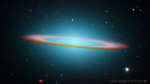 The Sombrero Galaxy in Infrared
4.10.2015
This floating ring is the size of a galaxy. In fact, it is a galaxy -- or at least part of one: the photogenic Sombrero Galaxy, one of the largest galaxies in the nearby Virgo Cluster of Galaxies.
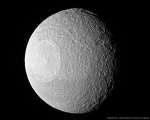 Odysseus Crater on Tethys
5.02.2017
Some moons wouldn't survive the collision. Tethys, one of Saturn's larger moons at about 1000 kilometers in diameter, survived the collision, but today exhibits the resulting expansive impact crater Odysseus. Sometimes called...
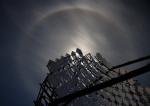 Halo and Hexagons
9.11.2006
As a bright November Moon lit up the night sky last week, Gil Esquerdo spotted this lovely Moon halo overhead at the Whipple Observatory on Mt. Hopkins, Arizona. In the foreground, the structure...
 Like a Diamond in the Sky
17.11.2012
A dark Sun hung over Queensland, Australia on Wednesday morning during a much anticipated total solar eclipse. Storm clouds threatened to spoil the view along the northern coast, but minutes before totality the clouds parted.
|
January February March April May June July August September October |
|||||||||||||||||||||||||||||||||||||||||||||||||