
|
You entered: rings
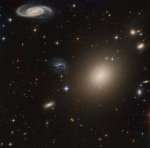 Galaxies Away
24.05.2018
This stunning group of galaxies is far, far away, about 450 million light-years from planet Earth and cataloged as galaxy cluster Abell S0740. Dominated by the cluster's large central elliptical galaxy (ESO 325-G004)...
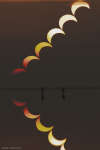 A Partial Solar Eclipse Sequence Reflected
26.12.2019
What's happened to the Sun? Yesterday, if you were in the right place at the right time, you could see the Sun rise partially eclipsed by the Moon. The unusual sight was captured...
 Shakespeare in Space
28.12.2023
In 1986, Voyager 2 became the only spacecraft to explore ice giant planet Uranus close up. Still, this newly released image from the NIRCam (Near-Infrared Camera) on the James Webb Space Telescope offers a detailed look at the distant world. The tilted outer planet rotates on its axis once in about 17 hours.
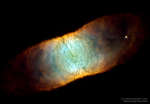 IC 4406: A Seemingly Square Nebula
7.01.2017
How can a round star make a square nebula? This conundrum comes to light when studying planetary nebulae like IC 4406. Evidence indicates that IC 4406 is likely a hollow cylinder, with its square appearance the result of our vantage point in viewing the cylinder from the side.
 Odyssey Over Mars
21.03.2002
Scroll right and journey for 300 kilometers over Terra Sirenum in the cratered highlands of southern Mars. The infrared view, 32 kilometers wide, was recently recorded by the THEMIS camera on board the orbiting Mars Odyssey spacecraft.
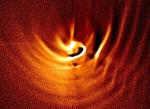 Hale-Bopp's Hoods
14.04.1997
Comet Hale-Bopp is spinning. The nucleus of the comet is a dirty snowball about 25 miles in diameter that spins about once every 12 hours. As Comet Hale-Bopp spins, parts of the comet's surface shoot away in jets.
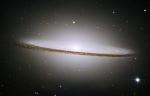 The Sombrero Galaxy from HST
14.01.2006
Why does the Sombrero Galaxy look like a hat? Reasons include the Sombrero's unusually large and extended central bulge of stars, and dark prominent dust lanes that appear in a disk that we see nearly edge-on. Billions of old stars cause the diffuse glow of the extended central bulge.
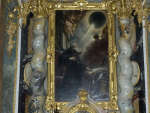 A Solar Eclipse Painting from the 1700s
27.01.2008
Is this painting the earliest realistic depiction of a total eclipse of the Sun? Some historians believe it is. The above painting was completed in 1735 by Cosmas Damian Asam, a painter and architect famous in early eighteenth century Germany.
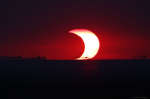 A Partial Eclipse Over Manila Bay
10.02.2018
What's happened to the setting Sun? An eclipse! In early 2009, the Moon eclipsed part of the Sun as visible from parts of Africa, Australia, and Asia. In particular the featured image, taken from the Mall of Asia seawall, caught a partially eclipsed Sun setting over Manila Bay in the Philippines.
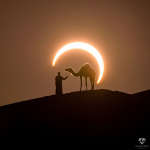 Solar Eclipse over the UAE
9.02.2020
What's happening behind that camel? A partial eclipse of the Sun. About six and a half weeks ago, the Moon passed completely in front of the Sun as seen from a narrow band on the Earth.
|
January February March April May June July August September October |
|||||||||||||||||||||||||||||||||||||||||||||||||