
|
You entered: satellite
 APOD: 2024 July 2 Б NGC 602: Oyster Star Cluster
2.07.2024
The clouds may look like an oyster, and the stars like pearls, but look beyond. Near the outskirts of the Small Magellanic Cloud, a satellite galaxy some 200 thousand light-years distant, lies this 5 million year old star cluster NGC 602.
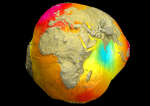 The Potsdam Gravity Potato
14.12.2014
Why do some places on Earth have higher gravity than others? Sometimes the reason is unknown. To help better understand the Earth's surface, sensitive measurments by the orbiting satellites GRACE and CHAMP were used to create a map of Earth's gravitational field.
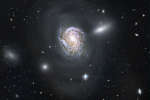 NGC 4911: Spiral Diving into a Dense Cluster
8.09.2010
Why are there faint rings around this spiral galaxy? Possibly because the galaxy, NGC 4911, is being pulled at by its neighbors as it falls into the enormous Coma Cluster of Galaxies.
 Bright Spots Resolved in Occator Crater on Ceres
16.09.2015
What created these bright spots on Ceres? The spots were first noted as the robotic Dawn spacecraft approached Ceres, the largest object in the asteroid belt, in February, with the expectation that the mystery would soon be solved in higher resolution images. However, even after Dawn arrived at Ceres in March, the riddle remained.
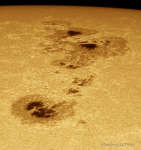 APOD: 2026 June 28 Б AR 4478: Giant Sunspot Group
28.06.2026
Right now, one of the largest sunspot groups in recent history is crossing the Sun. Active Region 4478 is not only big -- it's violent, showing tangled magnetic fields capable of throwing off huge clouds of particles into the Solar System. Some of these CMEs might impact the Earth.
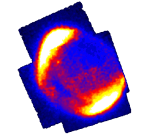 SN 1006: Pieces of the Cosmic Ray Puzzle
16.10.1996
Research balloon flights conducted in 1912 by Austrian physicist Victor Hess revealed that the Earth was constantly bombarded by high energy radiation from space - which came to be called "Cosmic Rays". What are Cosmic Rays and where do they come from?
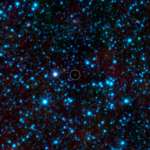 The Coldest Brown Dwarf
30.08.2011
This cosmic snapshot composed with image data from NASA's Wide-field Infrared Survey Explorer (WISE) satellite captures a multitude of faint stars and distant galaxies toward the constellation Lyra at wavelengths longer than visible light. But the object circled at the center is not quite a star.
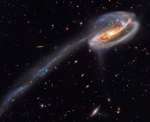 Arp 188 and the Tadpole s Tail
8.11.2012
In this stunning vista, based on image data from the Hubble Legacy Archive, distant galaxies form a dramatic backdrop for disrupted spiral galaxy Arp 188, the Tadpole Galaxy. The cosmic tadpole is a mere 420 million light-years distant toward the northern constellation Draco.
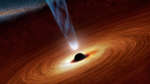 Spin up of a Supermassive Black Hole
12.03.2013
How fast can a black hole spin? If any object made of regular matter spins too fast -- it breaks apart. But a black hole might not be able to break apart -- and its maximum spin rate is really unknown.
 Deep Magellanic Clouds Image Indicates Collisions
25.07.2016
Did the two most famous satellite galaxies of our Milky Way Galaxy once collide? No one knows for sure, but a detailed inspection of deep images like that featured here give an indication that they have.
|
January February March April May June July August |
||||||||||||||||||||||||||||||||||||||||||||||||||||||||