
|
You entered: satellite
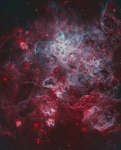 The Tarantula Zone
13.11.2020
The Tarantula Nebula, also known as 30 Doradus, is more than a thousand light-years in diameter, a giant star forming region within nearby satellite galaxy the Large Magellanic Cloud. About 180 thousand light-years away, it's the largest, most violent star forming region known in the whole Local Group of galaxies.
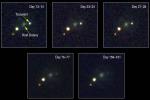 Gamma Ray Burst, Supernova Bump
17.05.2002
On the 21st of November 2001, satellites detected yet another burst of gamma-rays from the cosmos. While this flash of high-energy photons lasted for less than a minute, eager astronomers have been following the fading optical light from the location of the burst source ever since.
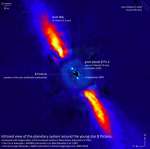 A Giant Planet for Beta Pic
3.07.2010
A mere 50 light-years away, young star Beta Pictoris became one of the most important stars in the sky in the early 1980s. Satellite and ground-based telescopic observations revealed the presence of a surrounding...
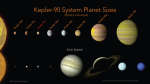 The Kepler 90 Planetary System
18.12.2017
Do other stars have planetary systems like our own? Yes -- one such system is Kepler-90. Cataloged by the orbiting Kepler satellite, an eighth planet has now been discovered giving Kepler-90 the same number of known planets as our Solar System.
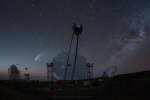 MAGIC NEOWISE
24.07.2020
The multi-mirror, 17 meter-diameter MAGIC telescopes reflect this starry night sky from the Roque de los Muchachos European Northern Observatory on the Canary Island of La Palma. MAGIC stands for Major Atmospheric Gamma Imaging...
 Charon: Moon of Pluto
3.06.2023
A darkened and mysterious north polar region known to some as Mordor Macula caps this premier high-resolution view. The portrait of Charon, Pluto's largest moon, was captured by New Horizons near the spacecraft's closest approach on July 14, 2015.
 APOD: 2025 June 27 Б Messier 109
27.06.2025
Big beautiful barred spiral galaxy Messier 109 is the 109th entry in Charles Messier's famous catalog of bright Nebulae and Star Clusters. You can find it just below the Big Dipper's bowl in the northern constellation Ursa Major.
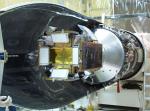 HETE-2 Rides Pegasus
12.10.2000
The Stargazer, a modified Lockheed L-1011 aircraft, soared into the skies above Kwajalein Atoll in the pacific on October 9th. A small satellite observatory known as the High Energy Transient Explorer - 2 (HETE-2) was tucked into Stargazer's winged Pegasus rocket, slung beneath the large trimotor jet's fuselage.
 APOD: 2023 May 31 Б Simulation: A Disk Galaxy Forms
31.05.2023
How did we get here? We know that we live on a planet orbiting a star orbiting a galaxy, but how did all of this form? Since our universe moves too slowly to watch, faster-moving computer simulations are created to help find out.
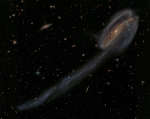 Arp 188 and the Tadpoles Tail
25.08.2014
Why does this galaxy have such a long tail? In this stunning vista, based on image data from the Hubble Legacy Archive, distant galaxies form a dramatic backdrop for disrupted spiral galaxy Arp 188, the Tadpole Galaxy. The cosmic tadpole is a mere 420 million light-years distant toward the northern constellation Draco.
|
January February March April May June July August |
||||||||||||||||||||||||||||||||||||||||||||||||||||||||