
|
You entered: stars
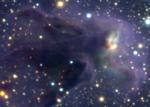 M16: Infrared Star Hunt
3.01.2002
The head of an interstellar gas and dust cloud is shown here in false-color, a near-infrared view recorded by astronomers hunting for stars within M16's Eagle Nebula. Made famous in a 1995 Hubble...
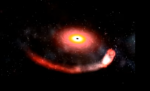 Unusual Signal Suggests Neutron Star Destroyed by Black Hole
2.09.2019
What created this unusual explosion? Three weeks ago, gravitational wave detectors in the USA and Europe -- the LIGO and Virgo detectors -- detected a burst of gravitational radiation that had the oscillating pattern expected when a black hole destroys a neutron star.
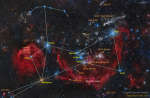 Official Star Names for Orion
3.12.2016
Familiar stars in Orion and constellations across the sky now have official names. Over the past year, the International Astronomical Union, the only body officially tasked with naming stars, approved names already in common use for 227 of the brightest stars, including the most famous stars on the sky Sirius, Polaris, and Betelgeuse.
 Young Star Cluster NGC 346
1.05.2025
The most massive young star cluster in the Small Magellanic Cloud is NGC 346, embedded in our small satellite galaxy's largest star forming region some 210,000 light-years distant. Of course the massive stars of NGC 346 are short lived, but very energetic.
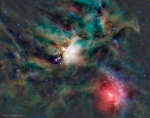 Young Stars in the Rho Ophiuchi Cloud
16.11.2019
How do stars form? To help find out, astronomers created this tantalizing false-color composition of dust clouds and embedded newborn stars in infrared wavelengths with WISE, the Wide-field Infrared Survey Explorer. The cosmic canvas...
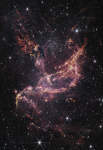 Young Star Cluster NGC 346
12.01.2023
The most massive young star cluster in the Small Magellanic Cloud is NGC 346, embedded in our small satellite galaxy's largest star forming region some 210,000 light-years distant. Of course the massive stars of NGC 346 are short lived, but very energetic.
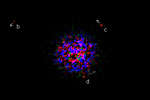 HR 8799: Discovery of a Multi planet Star System
16.11.2008
How common are planetary systems like our own Solar System? In the twelve years previous to 2008, over 300 candidate planetary systems have been found orbiting nearby stars. None, however, were directly imaged, few showed evidence for multiple planets, and many had a Jupiter-sized planet orbiting inside the orbit of Mercury.
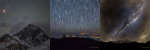 Highest, Tallest, and Closest to the Stars
24.02.2016
Fans of planet Earth probably recognize its highest mountain, the Himalayan Mount Everest, on the left in this 3-panel skyscape of The World at Night. Shrouded in cloud Everest's peak is at 8,848 meters (29,029 feet) elevation above sea level.
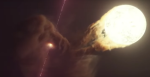 APOD: 2020 August 31 Б SS 433: Binary Star Micro Quasar
30.08.2020
SS 433 is one of the most exotic star systems known. Its unremarkable name stems from its inclusion in a catalog of Milky Way stars which emit radiation characteristic of atomic hydrogen. Its remarkable behavior stems from a compact object, a black hole or neutron star, which has produced an accretion disk with jets.
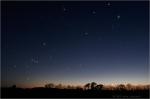 Constellation Construction
20.07.2006
This lovely twilight scene, recorded last April, finds a young crescent Moon low in the west at sunset. Above it, stars shine in the darkening sky but they too are soon to drop below the western horizon.
|
January February March April May June July August September October |
|||||||||||||||||||||||||||||||||||||||||||||||||