
|
You entered: stars
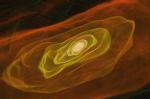 Zooming in on the First Stars
10.06.2003
What became of the first stars? No known stars appear to be composed of truly primordial gas -- all of the stars around us have too many heavy elements. Our own Sun is thought to be a third generation star, with many second-generation stars seen in globular clusters.
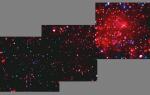 X Ray Stars and Winds in the Rosette Nebula
19.10.2001
This mosaic of x-ray images cuts a swath across the photogenic Rosette Nebula, a stellar nursery 5,000 light-years from Earth in the constellation Monoceros, the Unicorn. Constructed from data recorded by the orbiting...
 APOD: 2023 July 25 Б The Eagle Nebula with Xray Hot Stars
25.07.2023
What do the famous Eagle Nebula star pillars look like in X-ray light? To find out, NASA's orbiting Chandra X-ray Observatory peered in and through these interstellar mountains of star formation.
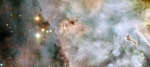 Massive Stars Resolved in the Carina Nebula
1.12.2008
How massive can stars be? Big, hefty stars live short violent lives that can profoundly affect their environments. Isolating a massive star can be problematic, however, since what seems to be a single bright star might actually turn out to be several stars close together.
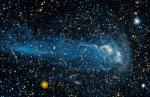 The Tail of a Wonderful Star
17.08.2007
To seventeenth century astronomers, Omicron Ceti or Mira was known as a wonderful star, a star whose brightness could change dramatically in the course of about 11 months. Mira is now seen as the archetype of an entire class of long-period variable stars.
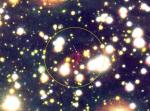 375: Candidate Quark Star
14.04.2002
Why is RJX J185635-375 so cool and so dim? Previously, this compact star held claim to being the closest neutron star -- only 150 light-years away. Now new observations and analysis indicate not only a cool temperature for RXJ J185635-375, pictured above, but also a larger distance: roughly 450 light-years away.
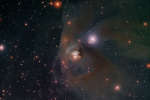 T Tauri: A Star is Formed
3.08.2009
What does a star look like when it is forming? The prototypical example is the variable star T Tauri, visible as the bright orange star near the image center. The orange star centered in this remarkable telescopic skyview is T Tauri, prototype of the class of T Tauri variable stars.
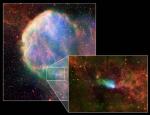 IC 443: Supernova Remnant and Neutron Star
2.06.2006
IC 443 is typical of the aftermath of a stellar explosion, the ultimate fate of massive stars. Seen in this false-color composite image, the supernova remnant is still glowing across the spectrum, from radio...
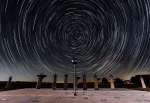 Star Trails and the Bracewell Radio Sundial
13.07.2018
Sundials use the location of a shadow to measure the Earth's rotation and indicate the time of day. So it's fitting that this sundial, at the Very Large Array Radio Telescope Observatory in New Mexico, commemorates the history of radio astronomy and radio astronomy pioneer Ronald Bracewell.
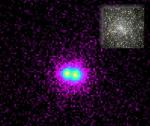 X Ray Stars in M15
20.09.2001
Side by side, two x-ray stars greeted astronomers in this false-color Chandra Observatory x-ray image of a region near the core of globular star cluster M15. The greeting was a pleasant surprise, as all previous x-ray images of the cluster showed only one such source where Chandra's sharper x-ray vision now reveals two.
|
January February March April May June July August September October |
|||||||||||||||||||||||||||||||||||||||||||||||||