
|
You entered: stars
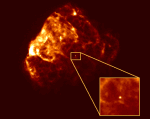 Supernova Remnant and Neutron Star
25.04.1998
A massive star ends life as a supernova, blasting its outer layers back to interstellar space. The spectacular death explosion is initiated by the collapse of what has become an impossibly dense stellar core. However, this core is not necessarily destroyed.
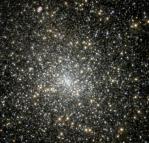 M15: Dense Globular Star Cluster
4.08.2000
Life might get dull at the core of M15 but the sky would always be bright with stars! In fact, only 40,000 light-years away in the constellation Pegasus, M15 is one of the most densely packed globular star clusters in our Milky Way Galaxy.
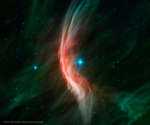 Zeta Oph: Runaway Star
5.07.2015
Like a ship plowing through cosmic seas, runaway star Zeta Ophiuchi produces the arcing interstellar bow wave or bow shock seen in this stunning infrared portrait. In the false-color view, bluish Zeta...
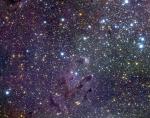 M16: Stars, Pillars and the Eagle s EGGs
3.01.2002
The Hubble Space Telescope's 1995 image of pillars of dust and gas, light-years long, within the Eagle Nebula (M16) was sensational. The three prominent pillars in that close-up visible light picture also appear...
 Phi Persei: Double Star
2.10.1999
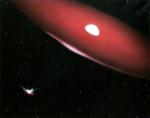
It's clear who is the biggest star in this binary system. Based on recent results, this artist's vision of the double star Phi Persei, 720 light years away, shows a bright, rapidly rotating massive star surrounded by a disk of gas. A small companion star orbits 100 million miles away.
 Stars and Dust Across Corona Australis
12.09.2013
Cosmic dust clouds sprawl across a rich field of stars in this sweeping telescopic vista near the northern boundary of Corona Australis, the Southern Crown. Less than 500 light-years away the dust clouds effectively block light from more distant background stars in the Milky Way.
 STARFORGE: A Star Formation Simulation
23.06.2021
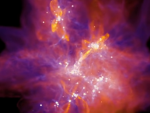
How do stars form? Most form in giant molecular clouds located in the central disk of a galaxy. The process is started, influenced, and limited by the stellar winds, jets, high energy starlight, and supernova explosions of previously existing stars.
 Bright Stars, Dim Galaxy
14.10.1996
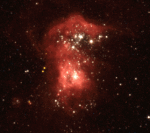
These two clusters of bright, newly formed stars surrounded by a glowing nebula lie 10 million light years away in the dim, irregular galaxy cataloged as NGC 2366. The Hubble Space Telescope image shows...
 Zeta Oph: Runaway Star
4.02.2011
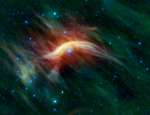
Like a ship plowing through cosmic seas, runaway star Zeta Ophiuchi produces the arcing interstellar bow wave or bow shock seen in this stunning infrared portrait from the WISE spacecraft. In the false-color view...
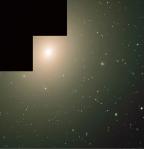 Young Star Clusters in an Old Galaxy
4.07.2002
Elliptical galaxy NGC 4365 is old, probably about 12 billion years old. Like most elliptical galaxies, this galaxy was thought to be full of old stars too, its burst of star forming activity having long since ended.
|
January February March April May June July August September October |
|||||||||||||||||||||||||||||||||||||||||||||||||