
|
You entered: stars
 Globular Star Cluster NGC 6752
24.10.2024
Some 13,000 light-years away toward the southern constellation Pavo, the globular star cluster NGC 6752 roams the halo of our Milky Way galaxy. Over 10 billion years old, NGC 6752 follows clusters Omega Centauri, 47 Tucanae, and Messier 22 as the fourth brightest globular in planet Earth's night sky.
 The Nebula And The Neutron Star
25.10.2000
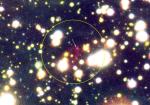
The lonely RX J1856.5-3754 was formed from the collapsed core of an exploding star. At a distance of 180 light-years it is the closest known neutron star. More massive than...
 Simulation: Formation of the First Stars
29.06.2021
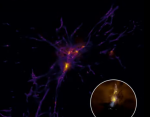
How did the first stars form? To help find out, the SPHINX computer simulation of star formation in the very early universe was created, some results of which are shown in the featured video. Time since the Big Bang is shown in millions of years on the upper left.
 The Galactic Center in Stars, Gas, and Magnetism
1.06.2021
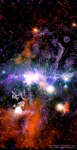
What's going on near the center of our galaxy? To help find out, a newly detailed panorama has been composed that explores regions just above and below the galactic plane in radio and X-ray light.
 APOD: 2025 September 23 Б NGC 6357: Cathedral to Massive Stars
22.09.2025
How massive can a normal star be? Estimates made from distance, brightness and standard solar models had given one star in the open cluster Pismis 24 over 200 times the mass of our Sun, making it one of the most massive stars known.
 Mira: The Wonderful Star
5.05.2005
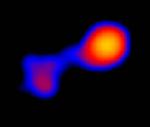
To seventeenth century astronomers, Omicron Ceti or Mira was known as a wonderful star - a star whose brightness could change dramatically in the course of about 11 months. Modern astronomers now recognize an entire class of long period Mira-type variables as cool, pulsating, red giant stars, 700 or so times the diameter of the Sun.
 X-Ray Stars Of Orion
3.02.2000
The stars of Orion shine brightly in northern winter skies where the constellation harbors the closest large stellar nursery, the Great Nebula of Orion, a mere 1500 light-years away. In fact, the apparently bright...
 The Once and Future Stars of Andromeda
22.05.2022
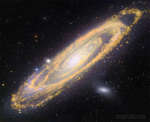
This picture of Andromeda shows not only where stars are now, but where stars will soon be. Of course, the big, beautiful Andromeda Galaxy, M31, is a spiral galaxy -- and a mere 2.5 million light-years away.
 The Once and Future Stars of Andromeda
6.10.2023
This picture of Andromeda shows not only where stars are now, but where stars will be. The big, beautiful Andromeda Galaxy, M31, is a spiral galaxy a mere 2.5 million light-years away. Image data...
 Bright Stars, Dim Galaxy
2.11.2001
These two clusters of bright, newly formed stars surrounded by a glowing nebula lie 10 million light-years away in the dim, irregular galaxy cataloged as NGC 2366. The Hubble Space Telescope image shows that...
|
January February March April May June July August September October |
|||||||||||||||||||||||||||||||||||||||||||||||||