
|
You entered: stars
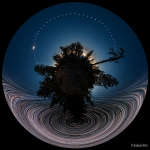 Panoramic Eclipse Composite with Star Trails
30.08.2017
What was happening in the sky during last week's total solar eclipse? This featured little-planet, all-sky, double time-lapse, digitally-fused composite captured celestial action during both night and day from a single location.
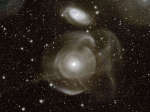 Galaxy NGC 474: Shells and Star Streams
5.01.2014
What's happening to galaxy NGC 474? The multiple layers of emission appear strangely complex and unexpected given the relatively featureless appearance of the elliptical galaxy in less deep images. The cause...
 APOD: 2024 July 2 Б NGC 602: Oyster Star Cluster
2.07.2024
The clouds may look like an oyster, and the stars like pearls, but look beyond. Near the outskirts of the Small Magellanic Cloud, a satellite galaxy some 200 thousand light-years distant, lies this 5 million year old star cluster NGC 602.
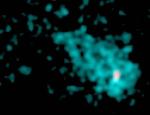 IC443's Neutron Star
15.12.2000
Using x-ray data from the orbiting Chandra Observatory along with radio data from the Very Large Array, a team of researchers has discovered evidence for a new example of one of the most bizarre objects known to modern astrophysics -- a neutron star.
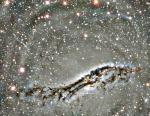 Centaurus A: Young Blue Star Stream
17.10.2002
Almost lost in this cosmic jumble of stars, gas and dust is a faint but definite blue arc -- a stream of young stars whose formation was probably triggered as a small dwarf galaxy was torn apart approaching the giant elliptical galaxy Centaurus A.
 Phi Persei: Double Star
12.12.1997
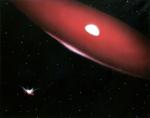
It's clear who is the biggest star in this binary system. Based on recent results, this artist's vision of the double star Phi Persei, 720 light years away, shows a bright, rapidly rotating massive star surrounded by a disk of gas. A small companion star orbits 100 million miles away.
 J102815: A Star That Should Not Exist
7.09.2011
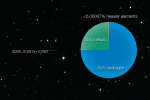
Why does this star have so few heavy elements? Stars born in the generation of our Sun have an expected abundance of elements heavier than hydrogen and helium mixed into their atmospheres. Stars born...
 A Spiral Nebula Surrounding Star R Sculptoris
16.10.2012
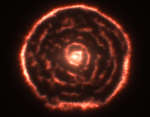
What's happening around that star? An unusual spiral structure has been discovered around the Milky Way star R Sculptoris, a red giant star located about 1,500 light years away toward the constellation of the Sculptor (Sculptoris).
 Zeta Oph: Runaway Star
8.04.2017
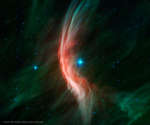
Like a ship plowing through cosmic seas, runaway star Zeta Ophiuchi produces the arcing interstellar bow wave or bow shock seen in this stunning infrared portrait. In the false-color view, bluish Zeta...
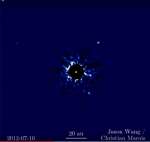 Four Planets Orbiting Star HR 8799
1.02.2017
Does life exist outside our Solar System? To help find out, NASA has created the Nexus for Exoplanet System Science (NExSS) to better locate and study distant star systems that hold hope of harboring living inhabitants.
|
January February March April May June July August September October |
|||||||||||||||||||||||||||||||||||||||||||||||||