
|
You entered: Earth
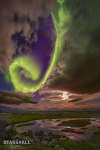 Spiral Aurora over Icelandic Divide
21.04.2019
Admire the beauty but fear the beast. The beauty is the aurora overhead, here taking the form of great green spiral, seen between picturesque clouds with the bright Moon to the side and stars in the background. The beast is the wave of charged particles that creates the aurora but might, one day, impair civilization.
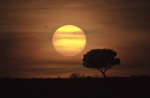 Sunspot Group 1429 and the Distant Sun
19.03.2012
What's that on the Sun? Over the past two weeks, one of the most energetic sunspot regions of recent years crossed the face of the Sun. Active Region 1429, visible above...
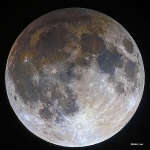 Penumbral Lunar Eclipse
12.10.2016
Does this Moon look a little different to you? Although shown in spectacular detail, the full face of Earth's most familiar satellite appears slightly darker than usual, in particular on the upper left, because it is undergoing a penumbral lunar eclipse.
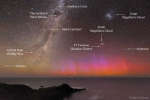 Red Aurora Over Australia
29.01.2017
Why would the sky glow red? Aurora. A solar storm in 2012, emanating mostly from active sunspot region 1402, showered particles on the Earth that excited oxygen atoms high in the Earth's atmosphere. As the excited element's electrons fell back to their ground state, they emitted a red glow.
 Comet Leonard from Space
15.12.2021
What does Comet Leonard look like from space? Today's featured image from Origin.Space's Yangwang-1 space telescope shows not only the currently bright comet -- but several other space delights as well. Taken...
 The Moon During a Total Lunar Eclipse
25.05.2021
How does the Moon's appearance change during a total lunar eclipse? The featured time-lapse video was digitally processed to keep the Moon bright and centered during the 5-hour eclipse of 2018 January 31. At first the full moon is visible because only a full moon can undergo a lunar eclipse.
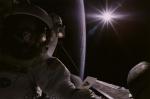 Dark Sky, Bright Sun
14.02.1999
In low Earth orbit there is not enough atmosphere to diffuse and scatter sunlight, so shadows are black and the sky is dark - even when the Sun shines. The harsh lighting produced this dramatic...
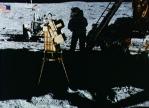 The First Lunar Observatory
11.11.2000
The first, and so far only, lunar astronomical observatory was deployed by the Apollo 16 crew in 1972. The Far Ultraviolet Camera / Spectrograph used a 3-inch diameter Schmidt telescope to photograph the Earth, nebulae, star clusters, and the Large Magellanic Cloud.
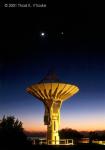 Bright Venus
8.03.2001
Have you seen a bright evening star in the western sky lately? That's no star, that's planet Venus the second "rock" from the Sun. Blazing at -4.6 magnitude, Venus, after the Sun and Moon, is the third brightest celestial body in planet Earth's sky.
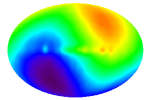 CMB Dipole: Speeding Through the Universe
15.06.2014
Our Earth is not at rest. The Earth moves around the Sun. The Sun orbits the center of the Milky Way Galaxy. The Milky Way Galaxy orbits in the Local Group of Galaxies. The Local Group falls toward the Virgo Cluster of Galaxies.
|
January February March April May June July August September October |
|||||||||||||||||||||||||||||||||||||||||||||||||