
|
You entered: Earth
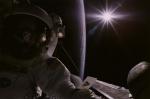 Dark Sky, Bright Sun
2.09.1997
In low Earth orbit there is not enough atmosphere to diffuse and scatter sunlight, so shadows are black and the sky is dark - even when the Sun shines. The harsh lighting produced this dramatic...
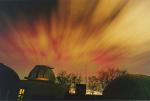 Aurora in Red and Yellow
10.04.2000
The past week brought some spectacular aurora to northern skies. These aurorae were caused by a large interplanetary shock wave that exploded from the Sun on April 4. When the shock wave reached the Earth on April 6, the resulting aurora could be seen in clear skies as far south as North Carolina.
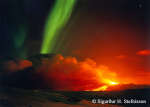 Volcano and Aurora in Iceland
8.07.2012
Sometimes both heaven and Earth erupt. In Iceland in 1991, the volcano Hekla erupted at the same time that auroras were visible overhead. Hekla, one of the most famous volcanoes in the world, has erupted at least 20 times over the past millennium, sometimes causing great destruction.
 Parhelia at Abisko
15.02.2025
Three suns seem to hug the horizon in this otherworldly winterscape. But the evocative scene was captured during a February 3rd snowmobile exploration of the mountainous region around Abisko National Park, northern Sweden, planet Earth.
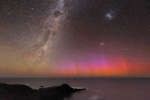 Red Aurora Over Australia
1.02.2012
Why would the sky glow red? Aurora. Last week's solar storms, emanating mostly from active sunspot region 1402, showered particles on the Earth that excited oxygen atoms high in the Earth's atmosphere. As the excited element's electrons fell back to their ground state, they emitted a red glow.
 AR 2192: Giant on the Sun
24.10.2014
As you (safely!) watched the progress of yesterday's partial solar eclipse, you probably also spotted a giant sunspot group. Captured in this sharp telescopic image from October 22nd the complex AR 2192 is beautiful to see, a sprawling solar active region comparable in size to the diameter of Jupiter.
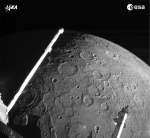 Mercury from Passing BepiColombo
28.06.2022
Which part of the Moon is this? No part -- because this is the planet Mercury. Mercury's old surface is heavily cratered like that of Earth's Moon. Mercury, while only slightly larger than Luna, is much denser and more massive than any Solar System moon because it is made mostly of iron.
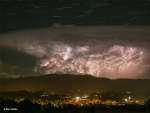 Star Trails and Lightning over the Pyrenees
19.09.2022
The beauty in this image comes in layers. On the bottom layer is the picturesque village of Manlleu in Barcelona, Spain. The six-minute exposure makes car lights into streaks. The next layer is a mountain -- Serra de Bellmunt -- of Europe's famous Pyrenees.
 Mars in the Loop
30.05.2025
This composite of images spaced a weather-permitting 5 to 9 days apart, from 2024 September 19 (top right) through 2025 May 18 (bottom left), faithfully traces ruddy-colored Mars as it makes a clockwise loop through the constellations Gemini and Cancer in planet Earth's night sky.
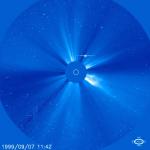 A Superior Conjunction Of Mercury
8.09.1999
In astronomical parlance, an interior planet is at superior conjunction when it is located on the opposite side of the Sun from Earth. Mercury, the solar system's innermost planet, zips past this point in its orbit today.
|
January February March April May June July August September October |
|||||||||||||||||||||||||||||||||||||||||||||||||