
|
You entered: Earth
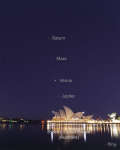 Planet Parade over Sydney Opera House
26.04.2022
The world is waking up to a picturesque planet parade. Just before dawn, the eastern skies over much of planet Earth are decorated by a notable line of familiar planets. In much of Earth...
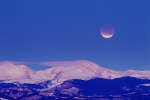 Eclipsed Moon in the Morning
24.12.2011
December's lunar eclipse graced early morning skies over the Rocky Mountains in Colorado, USA. There, this wintry scene finds the Moon in a cold blue twilight sky near the western horizon, above the snowy North American Continental Divide.
 Highest, Tallest, and Closest to the Stars
25.02.2016
Fans of planet Earth probably recognize its highest mountain, the Himalayan Mount Everest, on the left in this 3-panel skyscape of The World at Night. Shrouded in cloud Everest's peak is at 8,848 meters (29,029 feet) elevation above sea level.
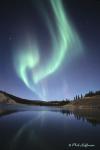 Dueling Auroras
3.12.2001
Will it be curtains for one of these auroras? A quick inspection indicates that it is curtains for both, as the designation "curtains" well categorizes the type of aurora pattern pictured. Another (informal) type is the corona. The above auroras resulted from outbursts of ionic particles from the Sun during the last week of September.
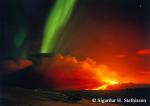 Volcano and Aurora in Iceland
21.01.2002
Sometimes both heaven and Earth erupt. In Iceland in 1991, the volcano Hekla erupted at the same time that auroras were visible overhead. Hekla, one of the most famous volcanoes in the world, has erupted at least 20 times over the past millennium, sometimes causing great destruction.
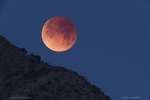 Moonset Eclipse
1.02.2018
Near the closest point in its orbit, the second Full Moon of the month occurred on January 31. So did the first Total Lunar Eclipse of 2018, as the Moon slid through planet Earth's shadow.
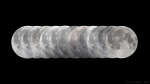 An Almost Eclipse of the Moon
18.01.2020
This composited series of images follows the Moon on January 10, the first Full Moon of 2020, in Hungarian skies. The lunar disk is in mid-eclipse at the center of the sequence though. It looks only slightly darker there as it passes through the light outer shadow or penumbra of planet Earth.
 APOD: 2025 July 2 Б Milky Way Through Otago Spires
2.07.2025
Does the Milky Way always rise between these two rocks? No. Capturing this stunning alignment took careful planning: being in the right place at the right time. In the featured image taken in June...
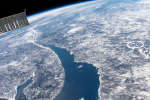 Manicouagan Impact Crater from Space
2.05.2019
Orbiting 400 kilometers above Quebec, Canada, planet Earth, the International Space Station Expedition 59 crew captured this snapshot of the broad St. Lawrence River and curiously circular Lake Manicouagan on April 11. Right of center, the ring-shaped lake is a modern reservoir within the eroded remnant of an ancient 100 kilometer diameter impact crater.
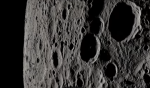 Apollo 13 Views of the Moon
3.03.2020
What if the only way to get back to Earth was to go around the far side of the Moon? Such was the dilemma of the Apollo 13 Crew in 1970 as they tried to return home in their unexpectedly damaged spacecraft.
|
January February March April May June July August September October |
|||||||||||||||||||||||||||||||||||||||||||||||||