
|
You entered: Earth
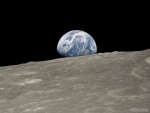 Earthrise 1: Historic Image Remastered
27.02.2022
"Oh my God! Look at that picture over there! Here's the Earth coming up. Wow is that pretty!" Soon after that pronouncement, 50 years ago today, one of the most famous images ever taken was snapped from the orbit of the Moon.
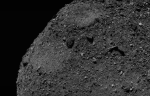 Tagging Bennu: The Movie
3.11.2020
This is what it looks like to punch an asteroid. Last month, NASA's robotic spacecraft OSIRIS-REx descended toward, thumped into, and then quickly moved away from the small near-Earth asteroid 101955 Bennu. The featured video depicts the Touch-And-Go (TAG) sampling event over a three-hour period.
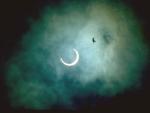 A Fleeting Eclipse
27.08.1997
A lunar eclipse can be viewed in a leisurely fashion. Visible to anyone on the night side of planet Earth (weather permitting), totality often lasts an hour or so as the moon glides through the Earth's shadow. But a solar eclipse is more fleeting.
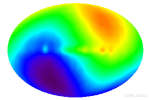 CMB Dipole: Speeding Through the Universe
3.04.2022
Our Earth is not at rest. The Earth moves around the Sun. The Sun orbits the center of the Milky Way Galaxy. The Milky Way Galaxy orbits in the Local Group of Galaxies. The Local Group falls toward the Virgo Cluster of Galaxies.
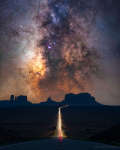 APOD: 2025 November 9 Б Road to the Galactic Center
9.11.2025
Does the road to our galaxy's center go through Monument Valley? It doesn't have to, but if your road does -- take a picture. In this case, the road is US Route 163 and iconic buttes on the Navajo National Reservation populate the horizon.
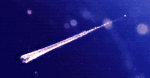 Catching Falling Stardust
25.01.1996
This carrot shaped track is actually little more than 5 hundredths of an inch long. It is the trail of a meteroid through a gel exposed to space in low earth orbit by the shuttle launched EURECA (European Recoverable Carrier) spacecraft.
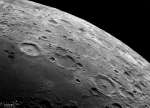 Lunar Craters Langrenus and Petavius
11.11.2019
The history of the Moon is partly written in its craters. Pictured here is a lunar panorama taken from Earth featuring the large craters Langrenus, toward the left, and Petavius, toward the right. The craters formed in separate impacts.
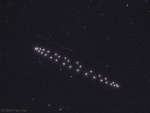 APOD: 2026 May 6 Б The Retrograde Dance of Saturn and Neptune
6.05.2026
What does it mean for Saturn and Neptune to be in retrograde? Featured is a composite of images taken over 34 nights from May 2025 to February 2026 tracing Saturn (brighter, foreground) and Neptune (dimmer, background). Over that time, the two planets exhibited retrograde motion, meaning they appeared to move backward in the sky.
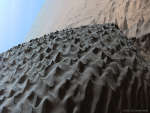 Dark Dunes on Mars
20.07.2016
How does wind affect sand on Mars? To help find out if it differs significantly from Earth, the robotic Curiosity rover on Mars was directed to investigate the dark Namib Dune in the Bagnold Dune Field in Gale Crater. Namib is the first active sand dune investigated up close outside of planet Earth.
 APOD: 2024 September 30 Б Comet Tsuchinshan ATLAS over Mexico
30.09.2024
The new comet has passed its closest to the Sun and is now moving closer to the Earth. C/2023 A3 (TsuchinshanБATLAS) is currently moving out from inside the orbit of Venus and on track to pass its nearest to the Earth in about two weeks.
|
January February March April May June July August September October |
|||||||||||||||||||||||||||||||||||||||||||||||||