
|
You entered: Earth
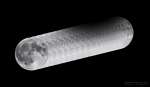 Caterpillar Moon
24.05.2013
A close series of consecutive exposures are combined in this intriguing composite of the Full Moon slowly crawling, across the sky. Beginning on the upper right at 19:42 UT and ending...
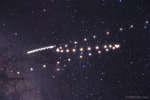 Retrograde Mars and Saturn
14.09.2016
Wandering Mars and Saturn have spent much of this year remarkably close in planet Earth's night sky. In a sequence of exposures spanning mid-December 2015 through the beginning of this week, this composited...
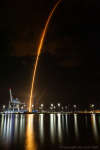 Crew 1 Mission Launch Streak
18.11.2020
Leaving planet Earth for a moment, a SpaceX Falcon 9 rocket arced into the early evening sky last Sunday at 7:27 pm EST. This 3 minute 20 second exposure traces the launch streak over Kennedy Space Center's Launch Complex 39A.
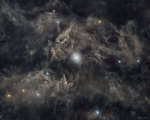 North Star: Polaris and Surrounding Dust
27.04.2021
Why is Polaris called the North Star? First, Polaris is the nearest bright star toward the north spin axis of the Earth. Therefore, as the Earth turns, stars appear to revolve around Polaris, but Polaris itself always stays in the same northerly direction -- making it the North Star.
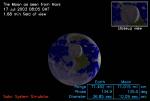 Mars Simulated View
16.07.2003
When earthdweller Patrick Vantuyne wondered what his home planet's single large moon would look like if viewed from Mars on July 17, he availed himself of the JPL Solar System Simulator. Of course...
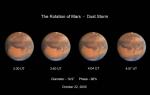 October Mars
28.10.2005
This October, Mars has become a bright, yellowish star in planet Earth's sky as it approaches oppositon, the period when Mars and Earth pass close as they orbit the Sun. How close is Mars? A mere 70 million kilometers or so, close enough to allow Earth-bound astronomers excellent views of the alluring Red Planet.
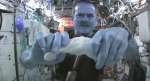 Wringing a Wet Towel in Orbit
24.04.2013
What happens if you wring out a wet towel while floating in space? The water shouldn't fall toward the floor because while orbiting the Earth, free falling objects will appear to float. But will the water fly out from the towel, or what? The answer may surprise you.
 A Mercury Transit Sequence
3.05.2016
This coming Monday, Mercury will cross the face of the Sun, as seen from Earth. Called a transit, the last time this happened was in 2006. Because the plane of Mercury's orbit is not exactly coincident with the plane of Earth's orbit, Mercury usually appears to pass over or under the Sun.
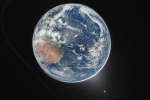 APOD: 2026 April 4 Б Hello World
3.04.2026
From pole to pole our fair planet is captured in this snapshot from space, an evocative image from a window of the Orion spacecraft Integrity. From the spacecraft's perspective the Sun is moving behind Earth's bright limb along the lower right.
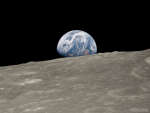 Earthrise 1: Historic Image Remastered
23.12.2018
"Oh my God! Look at that picture over there! Here's the Earth coming up. Wow is that pretty!" Soon after that pronouncement, 50 years ago today, one of the most famous images ever taken was snapped from the orbit of the Moon.
|
January February March April May June July August September October |
|||||||||||||||||||||||||||||||||||||||||||||||||