
|
You entered: hot star
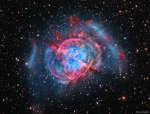 M27: The Dumbbell Nebula
3.12.2019
Is this what will become of our Sun? Quite possibly. The first hint of our Sun's future was discovered inadvertently in 1764. At that time, Charles Messier was compiling a list of diffuse objects not to be confused with comets.
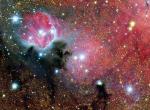 East of the Lagoon Nebula
20.05.2002
To the east of the Lagoon Nebula is a star field rich in diversity. On the lower left are clouds rich in dark dust that hide background stars and young star systems still forming. Dark clouds include LDN 227 on the left and IC 1275 on the right, with a bright star near its tip.
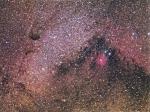 M24: A Sagittarius Starscape
21.09.2004
Many vast star fields in the plane of our Milky Way Galaxy are rich in clouds of dust, and gas. First and foremost, visible in the above picture are millions of stars, many of which are similar to our Sun.
 APOD: 2002 September 18- A Sagittarius Starscape
18.09.2002
Many vast star fields in the plane of our Milky Way Galaxy are rich in clouds of stars, dust, and gas. First and foremost, visible in the above picture are millions of stars, many of which are similar to our Sun.
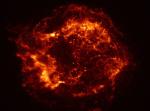 Chandras First Light: Cassiopeia A
27.08.1999
Cosmic wreckage from the detonation of a massive star is the subject of this official first image from NASA's Chandra X-ray Observatory. The supernova remnant, known as Cassiopeia A, was produced when a star exploded around 300 years ago in this northern sky constellation.
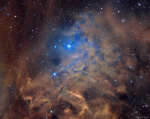 AE Aurigae and the Flaming Star Nebula
25.02.2018
Why is AE Aurigae called the flaming star? For one reason, the surrounding nebula IC 405 is named the Flaming Star Nebula because the region seems to harbor smoke, even though nothing is on fire, including interior star AE Aurigae.
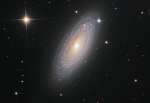 Spiral Galaxy NGC 2841
29.03.2008
Some 50 million light-years distant, spiral galaxy NGC 2841 can be found in the northern constellation of Ursa Major. This sharp view of the gorgeous island universe shows off a striking yellow nucleus and galactic disk with tightly wound spiral arms.
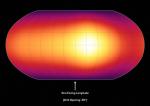 HD 189733b: Hot Jupiter
12.05.2007
HD 189733b is a Jupiter-sized planet known to orbit a star some 63 light-years away. But while the distant world is approximately the size of Jupiter, its close-in orbit makes it much hotter than our solar system's ruling gas giant.
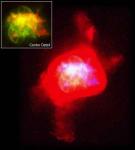 NGC 6210: The Turtle in Space Planetary Nebula
28.10.1998
A Turtle in Space? Planetary nebula NGC 6210 may look like a giant space turtle, but it is actually much more massive and violent. Fortunately, this gas cloud in Hercules lies about 6500 light years away.
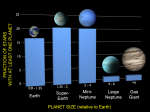 Ten Billion Earths
12.01.2013
How common are Earth-sized planets? Quite common, according to extrapolations from new data taken by NASA's orbiting Kepler spacecraft. Current computer models are indicating that at least one in ten stars are orbited by an Earth-sized planet, making our Milky Way Galaxy the home to over ten billion Earths.
|
January February March April May June July |
|||||||||||||||||||||||||||||||||||||||||||||||||