
|
You entered: star
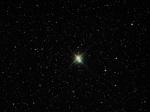 Albireo: A Bright and Beautiful Double
30.08.2005
Sometimes, even a small telescope can help unlock a hidden beauty of the heavens. Such is the case of the bright double star Albireo. Seen at even slight magnification, Albireo unfolds from a bright single point into a beautiful double star of strikingly different colors.
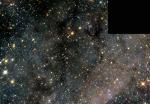 A Magellanic Starfield
4.01.2003
Stars of many types and colors are visible in this Hubble Space Telescope close-up of a starfield in the Large Magellanic Cloud (LMC). Over 10,000 stars are visible -- the brightest of which are giant stars. Were our Sun at the distance of these stars, about 170,000 light-years, it would hardly be discernable.
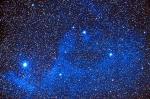 Starlight Reflections
14.04.1998
Wisps of dust fill the space between the stars. This dust is usually invisible, subtly acting to dim the light of more distant stars. Sometimes this dust is thick and prominent as dark patches on otherwise bright emission nebulae. Other times this dust may show itself by reflecting the light of bright, nearby stars.
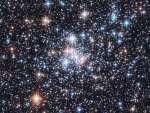 Open Cluster NGC 290: A Stellar Jewel Box
3.08.2008
Jewels don't shine this bright -- only stars do. Like gems in a jewel box, though, the stars of open cluster NGC 290 glitter in a beautiful display of brightness and color. The photogenic cluster, pictured above, was captured recently by the orbiting Hubble Space Telescope.
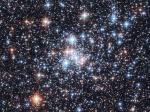 Open Cluster NGC 290: A Stellar Jewel Box
1.05.2006
Jewels don't shine this bright -- only stars do. Like gems in a jewel box, though, the stars of open cluster NGC 290 glitter in a beautiful display of brightness and color. The photogenic cluster, pictured above, was captured recently by the orbiting Hubble Space Telescope.
 Wild Duck Open Cluster M11
22.10.2000
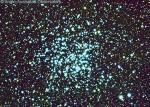
Many stars like our Sun were formed in open clusters. The above open cluster, M11, contains thousands of stars and is just over three thousand light years distant. The stars in this cluster all formed together about 150 million years ago. The bright young stars in M11 appear blue.
 Lynds Dark Nebula 43
30.10.2025
Sure, Halloween is an astronomy holiday. But astronomers always enjoy scanning the heavens for spook-tacular galaxies, stars, and nebulae. This favorite is item number 43 from the Beverly Lynds 1962 Catalog of Dark Nebulae, fondly known as the Cosmic Bat nebula.
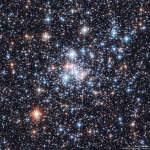 A Stellar Jewel Box: Open Cluster NGC 290
13.10.2019
Jewels don't shine this bright -- only stars do. Like gems in a jewel box, though, the stars of open cluster NGC 290 glitter in a beautiful display of brightness and color. The photogenic cluster, pictured here, was captured in 2006 by the orbiting Hubble Space Telescope.
 Nebulosity in Sagittarius
10.08.1997
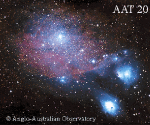
What causes the colors in this beautiful nebulosity in Sagittarius? Dubbed NGC 6589 and NGC 6590, the colors of this nebulosity, are caused by gas and dust. The blue color of the nebula nearest the bright stars is caused by reflection off interstellar dust.
 Webb's Rho Ophiuchi
25.10.2025
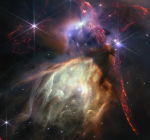
A mere 390 light-years away, Sun-like stars and future planetary systems are forming in the Rho Ophiuchi molecular cloud complex, the closest star-forming region to our fair planet. The James Webb Space Telescope's NIRCam peered into the nearby natal chaos to capture this infrared image at an inspiring scale.
|
January February March April May June July August September October |
|||||||||||||||||||||||||||||||||||||||||||||||||