
|
You entered: star
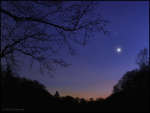
 Conjunction Haiku
7.04.2012
Sister planet stands together with sister stars. Celebrate the sky.
 APOD: 2025 October 14 Б An Unusual Globule in IC 1396
14.10.2025
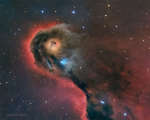
Is there a monster in IC 1396? Known to some as the Elephant's Trunk Nebula, parts of gas and dust clouds of this star formation region may appear to take on foreboding forms, some nearly human. The only real monster here, however, is a bright young star too far from Earth to hurt us.
 In the Heart of the Tarantula Nebula
27.10.1999
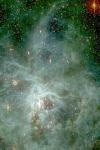
In the heart of monstrous Tarantula Nebula lies one of the most unusual star clusters. Known as NGC 2070 or R136, it is home to a great number of hot young stars. The energetic light from these stars continually ionizes nebula gas, while their energetic particle wind blows bubbles and defines intricate filaments.
 NGC 6369: A Donut Shaped Nebula
18.05.1998
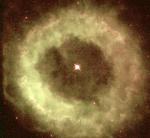
Why isn't the star in the center of the nebula? NGC 6369 appears to be a fairly ordinary planetary nebula. It can be seen with a good telescope in the constellation of Ophiuchus. The gas expelled by the central star is bunched in the shape of a donut or cylinder.
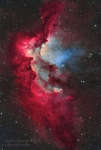 APOD: 2025 October 8 Б NGC 7380: The Wizard Nebula
8.10.2025
What powers are being wielded in the Wizard Nebula? Gravitation strong enough to form stars, and stellar winds and radiations powerful enough to create and dissolve towers of gas. Located only 8,000 light years away, the Wizard nebula, featured here, surrounds a developing open star cluster NGC 7380.
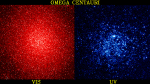 Globular Cluster Omega Centauri
4.10.1996
Does an old, red globular cluster have any hot, blue stars? The rightmost picture, taken by the Ultraviolet Imaging Telescope in ultraviolet light, shows that indeed it does. Pictured, Omega Centauri is the largest known globular cluster in our Galaxy, containing well over a million stars.
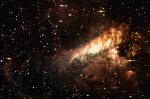 M17: The Omega Nebula
26.01.1999
The Omega Nebula contains glowing gas, dark dust, and some unusually massive stars. Also known as the M17 and the Swan Nebula, the Omega Nebula is about 5000 light-years away, 20 light-years across, and visible with binoculars in the constellation of Sagittarius.
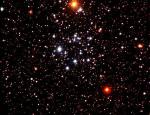 Open Cluster M50
28.01.1997
Many stars form in clusters. Two types of star clusters are visible in our Milky Way Galaxy: open clusters and globular clusters. Open clusters like M50, shown above, typically contain hundreds of stars, many of which are bright, young, and blue.
 Wild Duck Open Cluster M11
16.01.1996
Many stars like our Sun were formed in open clusters. The above open cluster, M11, contains thousands of stars and is just over three thousand light years distant. The stars in this cluster all formed together about 150 million years ago. The many bright stars in the cluster appear blue.
 Venus in the West
11.04.2015
In the coming days, Venus shines near the western horizon at sunset. To find Earth's sister planet in twilight skies just look for the brilliant evening star. Tonight very close to the Pleiades...
|
January February March April May June July August September October |
|||||||||||||||||||||||||||||||||||||||||||||||||