
|
You entered: star
 Zeta Oph: Runaway Star
29.12.2012
Like a ship plowing through cosmic seas, runaway star Zeta Ophiuchi produces the arcing interstellar bow wave or bow shock seen in this stunning infrared portrait. In the false-color view, bluish Zeta...
 Closest Star has Potentially Habitable Planet
25.08.2016
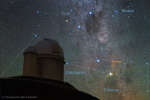
The star closest to the Sun has a planet similar to the Earth. As announced yesterday, recent observations confirmed that this planet not only exists but inhabits a zone where its surface temperature could allow liquid water, a key ingredient for life on Earth.
 W5: Pillars of Star Formation
15.12.2014
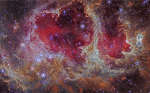
How do stars form? Images of the star forming region W5 like those in the infrared by NASA's Wide Field Infrared Survey Explorer (WISE) satellite provide clear clues with indications that massive stars near the center of empty cavities are older than stars near the edges.
 Mizar Binary Star
19.02.1997
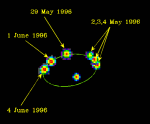
Mizar (sounds like "My Czar") is a binary star. In fact, most stars are binary stars. In a binary star system, each star of the pair follows an elliptical orbital path. Mutual gravity causes...
 APOD: 2024 February 20 Б AM1054: Stars Form as Galaxies Collide
20.02.2024
When galaxies collide, how many stars are born? For AM1054-325, featured here in a recently released image by the Hubble Space Telescope, the answer is millions. Instead of stars being destroyed as galaxy AM1054-325 and a nearby galaxy circle each other, their gravity and motion has ignited stellar creation.
 New Stars In 30 Doradus
1.10.1999
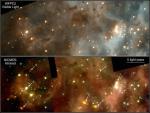
Compare these matched Hubble Space Telescope views (visible-light on top; infrared on bottom) of a region in the star-forming 30 Doradus Nebula. Find the numbered arrows in the infrared image which identify newborn massive stars. For example, arrows 1 and 5 both point to compact clusters of bright young stars.
 Zeta Oph: Runaway Star
4.01.2024
Like a ship plowing through cosmic seas, runaway star Zeta Ophiuchi produces the arcing interstellar bow wave or bow shock seen in this stunning infrared portrait. In the false-color view, bluish Zeta...
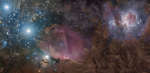 Orion in Gas, Dust, and Stars
29.09.2009
The constellation of Orion holds much more than three stars in a row. A deep exposure shows everything from dark nebula to star clusters, all imbedded in an extended patch of gaseous wisps in the greater Orion Molecular Cloud Complex.
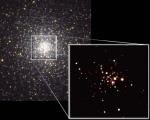 X Ray Stars of 47 Tucanae
24.05.2001
A deep optical image (left) of 47 Tucanae shows an ancient globular star cluster so dense and crowded that individual stars can not be distinguished in its closely packed core. An x-ray image of its central regions (inset right) from the Chandra Observatory reveals a wealth of x-ray stars hidden there.
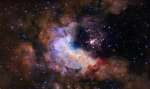 Celestial Fireworks: Into Star Cluster Westerlund 2
4.07.2017
What if you could go right into a cluster where stars are forming? A one-minute, time-lapse, video visualization of just this has been made with 3D computer modeling of the region surrounding the star cluster Westerlund 2, based on images from the Hubble Space Telescope in visible and infrared light.
|
January February March April May June July August September October |
|||||||||||||||||||||||||||||||||||||||||||||||||