
|
You entered: dust
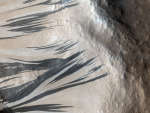 Slope Streaks in Acheron Fossae on Mars
1.03.2010
What creates these picturesque dark streaks on Mars? No one knows for sure. A leading hypothesis is that streaks like these are caused by fine grained sand sliding down the banks of troughs and craters. Pictured above, dark sand appears to have flowed hundreds of meters down the slopes of Acheron Fossae.
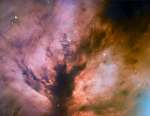 Flame Nebula Close Up
26.11.2010
Of course, the Flame Nebula is not on fire. Also known as NGC 2024, the nebula's suggestive reddish color is due to the glow of hydrogen atoms at the edge of the giant Orion molecular cloud complex some 1,500 light-years away.
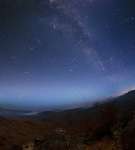 Lyrids in Southern Skies
24.04.2014
Earth's annual Lyrid meteor shower peaked before dawn on April 22nd, as our fair planet plowed through dust from the tail of long-period comet Thatcher. Even in the dry and dark Atacama desert along Chile's Pacific coast, light from a last quarter Moon made the night sky bright, washing out fainter meteor streaks.
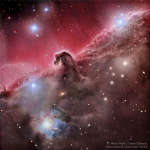 The Magnificent Horsehead Nebula
25.12.2016
Sculpted by stellar winds and radiation, a magnificent interstellar dust cloud by chance has assumed this recognizable shape. Fittingly named the Horsehead Nebula, it is some 1,500 light-years distant, embedded in the vast Orion cloud complex.
 The Seagull Nebula
19.01.2023
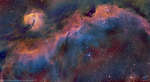
A broad expanse of glowing gas and dust presents a bird-like visage to astronomers from planet Earth, suggesting its popular moniker - The Seagull Nebula. Using narrowband image data, this 3-panel mosaic of the cosmic...
 Spiral Galaxy NGC 1232
30.09.1998
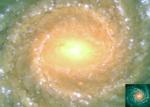
Galaxies are fascinating not only for what is visible, but for what is invisible. Grand spiral galaxy NGC 1232, recently captured in detail by the new Very Large Telescope, is a good example.
 The Seagull Nebula
8.03.2012
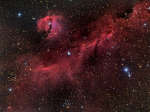
A broad expanse of glowing gas and dust presents a bird-like visage to astronomers from planet Earth, suggesting its popular moniker - The Seagull Nebula. This portrait of the cosmic bird covers a 1.6 degree wide swath across the plane of the Milky Way, near the direction of Sirius, alpha star of the constellation Canis Major.
 VdB 152: A Ghost in Cepheus
31.10.2012
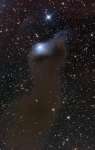
Described as a "dusty curtain" or "ghostly apparition", mysterious reflection nebula VdB 152 really is very faint. Far from your neighborhood on this Halloween Night, the cosmic phantom is nearly 1,400 light-years away. Also catalogued as Ced 201, it lies along the northern Milky Way in the royal constellation Cepheus.
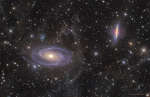 M81 versus M82
25.09.2013
Here in the Milky Way galaxy we have astronomical front row seats as M81 and M82 face-off, a mere 12 million light-years away. Locked in a gravitational struggle for the past billion years or so, the two bright galaxies are captured in this deep telescopic snapshot, constructed from 25 hours of image data.
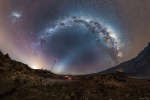 Milky Way and Zodiacal Light over Chile
9.03.2020
What is the band of light connecting the ground to the Milky Way? Zodiacal light -- a stream of dust that orbits the Sun in the inner Solar System. It is most easily seen just before sunrise, where it has been called a false dawn, or just after sunset.
|
January February March April May June July August September October |
|||||||||||||||||||||||||||||||||||||||||||||||||