
|
You entered: dust
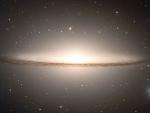 The Sombrero Galaxy from VLT
28.02.2000
Why does the Sombrero Galaxy look like a hat? Reasons include the Sombrero's unusually large and extended central bulge of stars, and dark prominent dust lanes that appear in a disk that we see nearly edge-on. Billions of old stars cause the diffuse glow of the extended central bulge.
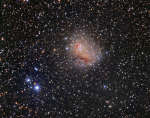 Starburst Galaxy IC 10
4.01.2012
Lurking behind dust and stars near the plane of our Milky Way Galaxy, IC 10 is a mere 2.3 million light-years distant. Even though its light is dimmed by intervening dust, the irregular dwarf galaxy still shows off vigorous star-forming regions that shine with a telltale reddish glow in this colorful skyscape.
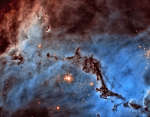 N11: Star Clouds of the LMC
11.02.2013
Massive stars, abrasive winds, mountains of dust, and energetic light sculpt one of the largest and most picturesque regions of star formation in the Local Group of Galaxies. Known as N11, the region...
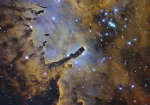 NGC 6823: Cloud Sculpting Star Cluster
8.10.2014
Star cluster NGC 6823 is slowly turning gas clouds into stars. The center of the open cluster, visible on the upper right, formed only about two million years ago and is dominated in brightness by a host of bright young blue stars.
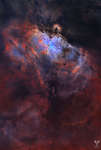 Star Forming Eagle Nebula without Stars
4.10.2022
The whole thing looks like an eagle. A closer look at the Eagle Nebula's center, however, shows the bright region is actually a window into the center of a larger dark shell of dust. Through this window, a brightly-lit workshop appears where a whole open cluster of stars is being formed.
 APOD: 2023 June 19 Б The Busy Center of the Lagoon Nebula
19.06.2023
The center of the Lagoon Nebula is a whirlwind of spectacular star formation. Visible near the image center, at least two long funnel-shaped clouds, each roughly half a light-year long, have been formed by extreme stellar winds and intense energetic starlight. A tremendously bright nearby star, Herschel 36, lights the area.
 Facing NGC 6946
26.07.2024
From our vantage point in the Milky Way Galaxy, we see NGC 6946 face-on. The big, beautiful spiral galaxy is located just 20 million light-years away, behind a veil of foreground dust and stars in the high and far-off constellation Cepheus.
 APOD: 2024 August 19 Б IC 5146: The Cocoon Nebula
19.08.2024
Inside the Cocoon Nebula is a newly developing cluster of stars. Cataloged as IC 5146, the beautiful nebula is nearly 15 light-years wide. Soaring high in northern summer night skies, it's located some 4,000 light years away toward the constellation of the Swan (Cygnus).
 The Dark Tower in Scorpius
22.08.2024
In silhouette against a crowded star field along the tail of the arachnological constellation Scorpius, this dusty cosmic cloud evokes for some the image of an ominous dark tower. In fact, monstrous clumps...
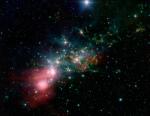 Dusty NGC 1333
24.11.2005
Dusty NGC 1333 is seen as a reflection nebula in visible light images, sporting bluish hues characteristic of starlight reflected by dust. But at longer infrared wavelengths, the interstellar dust itself glows - shown in red in this false-color Spitzer Space Telescope image.
|
January February March April May June July August September October |
|||||||||||||||||||||||||||||||||||||||||||||||||