
|
You entered: dust
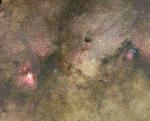 APOD: 2002 September 18- A Sagittarius Starscape
18.09.2002
Many vast star fields in the plane of our Milky Way Galaxy are rich in clouds of stars, dust, and gas. First and foremost, visible in the above picture are millions of stars, many of which are similar to our Sun.
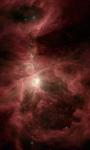 Spitzer s Orion
18.08.2006
Few cosmic vistas excite the imagination like the Orion Nebula, an immense stellar nursery some 1,500 light-years away. Also known as M42, the nebula is visible to the unaided eye, but this stunning...
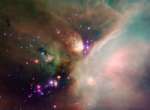 Young Stars in the Rho Ophiuchi Cloud
15.02.2008
Cosmic dust clouds and embedded newborn stars glow at infrared wavelengths in this tantalizing false-color view from the Spitzer Space Telescope. Pictured is of one of the closest star forming regions, part of the Rho Ophiuchi cloud complex some 400 light-years distant near the southern edge of the pronounceable constellation Ophiuchus.
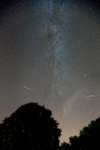 Night of the Perseids
14.08.2010
On the night of August 12, from moonset until dawn was a good time to see meteors. Enthusiasts watched as comet dust rained on planet Earth, streaking through dark skies during the annual Perseid Meteor Shower.
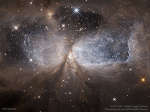 Star Forming Region S106
16.02.2016
Massive star IRS 4 is beginning to spread its wings. Born only about 100,000 years ago, material streaming out from this newborn star has formed the nebula dubbed Sharpless 2-106 Nebula (S106), featured here.
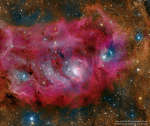 The Lagoon Nebula in High Definition
14.12.2016
Stars are battling gas and dust in the Lagoon Nebula but the photographers are winning. Also known as M8, this photogenic nebula is visible even without binoculars towards the constellation of Sagittarius. The energetic processes of star formation create not only the colors but the chaos.
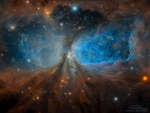 Star Forming Region S106
25.03.2020
Massive star IRS 4 is beginning to spread its wings. Born only about 100,000 years ago, material streaming out from this newborn star has formed the nebula dubbed Sharpless 2-106 Nebula (S106), featured here.
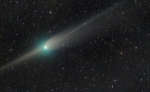 Comet ZTF: Orbital Plane Crossing
27.01.2023
The current darling of the northern night, Comet C/2022 E3 ZTF is captured in this telescopic image from a dark sky location at June Lake, California. Of course Comet ZTF has been growing brighter in recent days, headed for its closest approach to Earth on February 1.
 APOD: 2024 June 11 Б Colorful Stars and Clouds near Rho Ophiuchi
11.06.2024
Why is the sky near Antares and Rho Ophiuchi so colorful, yet dusty? The colors result from a mixture of objects and processes. Fine dust -- illuminated by starlight -- produces blue reflection nebulae. Gaseous clouds whose atoms are excited by ultraviolet starlight produce reddish emission nebulae. Backlit dust clouds block starlight and so appear dark.
 APOD: 2026 July 11 Б Messier 24: Sagittarius Star Cloud
11.07.2026
Unlike most entries in Charles Messier's famous catalog of deep sky objects, M24 is not a bright galaxy, star cluster, or nebula. It's a gap in nearby, obscuring interstellar dust clouds that allows a view of the distant stars in the Sagittarius spiral arm of our Milky Way galaxy.
|
January February March April May June July August September October |
|||||||||||||||||||||||||||||||||||||||||||||||||