
|
You entered: dust
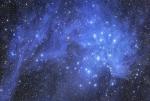 Pleiades and Stardust
21.11.2007
Hurtling through a cosmic dust cloud a mere 400 light-years away, the lovely Pleiades or Seven Sisters star cluster is well-known for its striking blue reflection nebulae. This remarkable wide-field (3 degree) image...
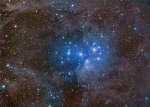 Pleiades and Stardust
14.10.2009
Have you ever seen the Pleiades star cluster? Perhaps the most famous star cluster on the sky, the Pleiades can be seen without binoculars from even the depths of a light-polluted city. Also known as the Seven Sisters and M45, the Pleiades is one of the brightest and closest open clusters.
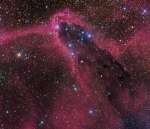 The Dark Tower in Scorpius
27.04.2011
In silhouette against a crowded star field toward the constellation Scorpius, this dusty cosmic cloud evokes for some the image of an ominous dark tower. In fact, clumps of dust and molecular gas collapsing...
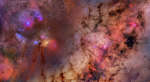 Scorpius Enhanced
15.06.2021
If Scorpius looked this good to the unaided eye, humans might remember it better. Scorpius more typically appears as a few bright stars in a well-known but rarely pointed out zodiacal constellation. To get a spectacular image like this, though, one needs a good camera, a dark sky, and some sophisticated image processing.
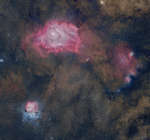 A Sagittarius Triplet
9.07.2024
These three bright nebulae are often featured on telescopic tours of the constellation Sagittarius and the crowded starfields of the central Milky Way. In fact, 18th century cosmic tourist Charles Messier cataloged two of them; M8, the large nebula above center, and colorful M20 below and left in the frame.
 APOD: 2025 May 27 Б Zeta and Rho Ophiuchi with Milky Way
26.05.2025
Behold one of the most photogenic regions of the night sky, captured impressively. Featured, the band of our Milky Way Galaxy runs diagonally along the bottom-left corner, while the colorful Rho Ophiuchi cloud complex is visible just right of center and the large red circular Zeta Ophiuchi Nebula appears near the top.
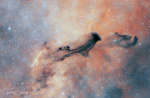 APOD: 2026 February 20 Б B93: A Dark Interstellar Ghost
19.02.2026
"A ghost in the Milky WayББ says Christian Bertincourt, the astrophotographer behind this striking image of Barnard 93 (B93). The 93rd entry in BarnardБs Catalogue of Dark Nebulae, B93 lies within the Small Sagittarius Star Cloud (Messier 24), where its darkness stands in stark contrast to bright stars and gas in the background.
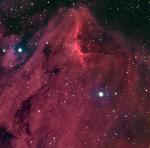 The Pelican in the Swan
29.08.2002
The Pelican Nebula, also known as IC 5070, lies about 2,000 light-years away in the high and far-off constellation of Cygnus, the Swan. This picture spans a portion of the magnificent nebula about 30 light-years wide.
 Massive Star Forming Region DR21 in Infrared
14.04.2004
Deep in the normally hidden recesses of giant molecular cloud DR21, a stellar nursery has been found creating some of the most massive stars yet recorded. The orbiting Spitzer Space Telescope's Infrared Array Camera opened the window into the cloud last year in mid- infrared light.
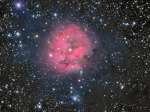 IC 5146: The Cocoon Nebula
27.08.2008
Inside the Cocoon Nebula is a newly developing cluster of stars. Cataloged as IC 5146, the beautiful nebula is nearly 15 light-years wide, located some 4,000 light years away toward the northern constellation Cygnus.
|
January February March April May June July August September October |
|||||||||||||||||||||||||||||||||||||||||||||||||